Saturday, 4 August 2012
Bottling It
My mum has saved an article from the Sunday Telegraph magazine, Stella, for me. Bee Wilson writes a weekly column called The Kitchen Thinker which generally includes thoughts on anything from the best chocolate brownie recipe to how the economic crisis might have changed the nation’s eating habits. The article my mum has saved this time is from mid July; titled ‘What a lotta bottles’, it tells of her hunt for reusable, non-leaky water bottles that she can fill with tap water from her home, instead of buying bottled water while she is out.
Sigg
I’ve never had too much of a water habit, only taking bottles with me if I’m going on a particularly long journey - on short journeys or if I’m just popping into town, I tend to go without, though this is perhaps not terribly healthy. What I mean to say is that I’m pretty good at not buying bottled drinks, except for the odd failure when I succumb to the lunchtime temptations of a Marks and Spencer smoothie (also not particularly healthy, given their sugar content). On journeys when I do take a bottle from home, I turn to my trusty Sigg bottle, bought for field trips when I was at University. Metal (aluminium), holds a litre of water and keeps it pretty fresh. No problem.
But now Bee Wilson tells me that Sigg bottles produced before 2008 used BPA in the bottle lining. This is no longer the case - Sigg say that, post 2008, bottles are produced without using the chemical. But wait, I was a Uni from 1999 to 2002. First: yikes - was it really that long ago? Second: yikes - this means I have been drinking from a BPA Sigg bottle for the last ten plus years. This does not make me very happy. Bye bye old Sigg bottle - there is no question that I will not be using it any longer.
To replacement... Do I buy a new Sigg bottle or do I chose a different brand? Apparently, before 2008, Sigg always used advertising that implied they never used BPA - until they admitted that, uh, yeah, actually they did after all. So, if they’ve already twisted the truth once, who’s to say they are’t now?
Why not re-use shop bottles?
Well, to state the obvious: they’re plastic. As Bee points out, “the PET material can leach small amounts of toxic antimony.” Plastic water bottles are designed and made for the purpose of a single use, and aren’t likely to withstand repeated washing and refilling. All plastic begins to break down with time and pressure - just like anything in this world does - and no matter how safe a manufacturer might say its plastic product is, how unlikely it is leach chemicals, that ‘safety’ is only limited to the manufacturer’s estimated time of use for that plastic product - which is only going to be for however long they think the original product is going to stay in it, and doesn’t apply to six months of daily refilling.
Other options
A quick google search for ‘plastic free water bottle’ gave me the top response of Kleen Kanteen. These are 100% stainless steel with no plastic liner, and cap options of either stainless steel or a BPA-free plastic. Any ‘decoration’ is with lead-free acrylic paint. And the plastic-free queen, Beth, over on My Plastic-Free Life, gives them her vote, which means they get my vote too.
On yer bike
I am definitely planning to purchase a Kleen Kanteen to replace my disgraced Sigg, but in the meantime I should probably confess to have recently, deliberately, purchased a plastic bottle.
Ok, so, I’ve been a bit reckless with my spending power of late. My parents don’t accept rent from me, and so the idea was that I’d save what I would otherwise be spending, in the hopes that maybe one day I’d have enough for a house deposit. What has actually happened is that I’ve been spending said ‘rent’ money on other things. Things like a three week trip to Seattle later this summer, a new clutch for my car, and a bike. Yes, I decided I should get some exercise. Granted I haven’t used my bike that much yet, but, hey, I’m working up to it. Anyway, after setting out for a ride a couple of weeks ago I realised I didn’t have a water bottle holder - or water bottle - for the bike. So, without particularly thinking about it, the next day I toddled off to my favoured bike shop and picked one up. The bottle holder itself is metal, but the only bottles available were, of course, plastic. I faithfully listened to the sales assistant who told me that I needed a bottle designed to fit the holder and so, without really thinking all that much about it, I bought the one he recommended.
This new bottle is a ‘Camelbak Podium’. I did no research into it, going only by what it said on the label, which told me that it is BPA free. It’s still plastic, though. 100% plastic, there’s no doubt about that. Obviously this is not something that I really condone - even if the plastic is ‘safe’ and BPA free, there is still the manufacturing process and the raw material costs to consider, as well as what will happen to it once I have moved past my bike phase or the bottle has come to the end of its ‘safe’ lifetime. So what I am to do? Well, (a) now I’ve bought it it would be wrong not to use it, and (b) unlike the everyday water bottles mentioned above, it is made and designed to make it safe for repeated washing and refilling, so should be safer to use for a longer time. But I wonder: if I buy a small size Kleen Kanteen, will it fit in my bike’s bottle holder after all?
Interesting links about water:
Water.org
Banthebottle.net
Story of Bottle Water

Wednesday, 27 June 2012
Bag It
I have just discovered a plastic documentary I hadn't previously heard of: Bag It - Is Your Life too Plastic? Watching the trailer gave me a strangely familiar feeling - yes, my life is too plastic; yes, these are all things I think about and worry about. It's like the guy is reading my mind.
Bag It Intro from Suzan Beraza on Vimeo.
Check out the Bag It website and the Bag It blog - well worth reading.
Bag It Intro from Suzan Beraza on Vimeo.
Check out the Bag It website and the Bag It blog - well worth reading.
Sunday, 17 June 2012
On 'Stuff'
I’ve been thinking about ‘stuff’ lately.
After living independently for over five years, I have accumulated quite a bit of stuff. Furniture, books, general household stuff, a vacuum leaner, a lawn mower, books, cutlery, cups, mugs, more books. Enough to fill a 30 foot square storage room. It may sound like a joke, but last time I went to get something out of this room, stuff had been piled in so high that it literally fell out onto me in a big crash, bang, wollop, when I opened the door.
It’s only stuff...
What is stuff? For a short time earlier this year I shared a house with my friend C. Then she sorted her life out, got a new job and moved to Whitby. This was a fairly major undertaking: she went from a two bedroom house and all the attendant ‘stuff’ to a single live-in room in the hotel she’s now managing, which meant a serious spring clean, whittling down her possessions to a mix of the absolute necessities and items of extreme sentimental value. She sent ahead five boxes of bits and pieces, books, clothes, toiletries, sewing machine, etc (or was it only four?), has a very small chest of breakable items stored in a friend’s garage, and on the day of her journey took two suitcases with her. To go from a two bed house to four boxes and two suitcases is pretty incredible, especially when I consider that, knowing her, most of that space was probably taken up by beauty products, nail varnish and knickers.
“It’s only stuff,” she said, when I expressed incredulity at what she was expelling from her life. And she’s right, of course. It is only stuff. Each item taken on its own is replaceable. She wasn’t going to need it in her new home, and there was nowhere for it to go in the meantime. While she separated less than fifty books from the two or three hundred on her bookshelves to keep, I separated around the same amount from my shelves to give away. While she posted lists of unneeded furniture on Freecycle, I stuffed mine back into my storage hole, filling the drawers with blankets and bed linen. While she copied music and DVDs onto a spanking new iPod, giving away the hard copies, I separated mine into ‘need to keep with me just in case I fancy watching them soon’ and ‘don’t need easy access to them, but don’t want to get rid of them’ piles.
But it’s my stuff...
So, I sit here and think about all my stuff shoved away into that little space in a countryside warehouse. A double bed, a wardrobe, coffee table. And I think, I really should sell it; I really don’t need it. Do I? And then I think, but I still want it. It’s my stuff and it cost me money. It’s an investment.
1. On one side it represents my past, and now I want to let go of that, because it’s past and it’s not coming back. I am not getting Bron back. He’s not who he was when we met and we can’t go back to how things were four, five years ago, no matter how much I dream it could be true. He is who is now and I am who I am now, and we don’t add up anymore.
2. But the flip side is that it’s also my future. I want my own place again, and when I get that I’m going to need furniture and plates and cutlery and bed linen.
Here is my line of thinking; I'm going to argue this out in words.
(a) I could give away or sell what I have now and buy new stuff again when I need it. The more I think about it, the more I like the idea of purging, of not having that room of stuff permanently in the back of my mind. Someone else might need these things right now and having them locked away is a waste.
(b) There are some things in that room that I really don’t want to get rid of. But there's no reason why I couldn't keep those particular things if I really wanted to.
(c) But: replacing anything I do get rid of at some future point will likely cost more than I’d get from selling them today. And the actual act of replacing them can be a stressful and time-consuming business.
(d) But then again, what if I am lucky enough to get an exciting new job somewhere outside of Cornwall? Transporting all that stuff out of the county is also going to be pretty stressful and time consuming.
(e) And so I find I have argued myself back to where I started.
But, then again, it’s only stuff and what, after all, is stuff? And the amount of brain time this stuff is causing me seems to indicate that stuff is probably more trouble than its worth. I look at C, and I look at another friend, B, who I met through Shortcourse and Hevva Hevva, who is living the lifestyle I profess to believe in: buying only second-hand, organising swap parties rather than going on shopping trips, and I think: I should be doing that.
I should be doing that. And the place to start is to just get in there and do it, to stop thinking about it, to stop questioning it and my attachments. Make a list and stick to it.
Any hints?
Friday, 1 June 2012
Back to it: Recycled or Degradable?
One of the things I'm often forced to consider when researching packaging policies is the question, what is better: recycled plastic or biodegradable plastic? It's the kind of question that can only be tackled with a pro/con list and even then the scales have a tendency to come out looking pretty balanced. In a previous post on the subject, The Fine Plastic Line, I came down on the side (just) of recycled plastic, because it means putting waste plastic back into the system rather than putting it into the ground. And this is why I supported Waterstones' bag policy, the company I work for, who sourced recycled plastic for their bags.
Mystery policy change...
Or, at least, they used to. Because I recently noticed two changes in the bags we're receiving in our store. Firstly, the littlest, greetings card-sized bags are no longer nice, traditional, brown recycled paper. Nope, only plastic ones are available now. And secondly, the texture of the plastic bags are different (large, medium and small alike). More glossy, less dusty. This is because, as further inspection revealed, they are no longer made from recycled plastic. They are now classed as degradable plastic, sourced from a company called EPI Global.
Ok, so for starters, here are two important terms. They sound pretty similar, but actually have quite different consequences.
1. Degradable. This applies to a plastic that is designed to "undergo a significant change in its chemical structure under specific environmental conditions" (source: http://www.epi-global.com/en/frequently-asked-questions.php#q4), leading to the point where it can no longer technically be defined as a 'plastic'. In other words, it simply breaks down to a certain point whereby it no longer resembles it's original form, e.g. is a pile of little pieces instead of a whole plastic bag.
2. Biodegradable. "A degradable plastic in which the degradation results from the action of naturally-occurring micro-organisms such as bacteria, fungi, and algae" (source: as above). In other words, it's broken down by living organisms. In the process of this, the organisms will consume and thus convert the materials' component parts into other things such as living material or gas.
These are two distinct processes and should not be confused. Degradable does not mean the material has gone, it simply means it doesn't look like it did before; it might have a slightly different chemical structure than it did before, but that doesn't necessarily equate to its being harmless. Biodegradable, however, is, in my opinion, much better and more valid - biodegradable is good because it means that the chemicals/materials are available for nature to make use of. Organisms aren't able to use or break down the chemicals in traditional plastics because the molecules are so tightly bound together they can't break them apart - and that's why plastic waste is such a massive problem, there's nowhere for it to go, no way for it to be cycled back into the world's natural systems. So, if anyone is wondering about buying a plastic that is marked as degradable, make sure it is biodegradable, otherwise it's pointless.
 EPI Global and TDPA
So what do EPI Global do? Well, they market a chemical called TDPA. TDPA stands for 'Totally Degrdadable Plastics Additives'. It's a chemical that plastics manufacturers can add to their product - e.g. a plastic bag - that, after a certain period of time, will catalyse that product's degradation. That means its presence will considerably increase the speed at which the bag will break down into smaller pieces. TDPA causes (a) the long polymer molecules that constitute plastic to be broken down into shorter molecules, and (b) promotes oxidation. The oxidation (i.e. oxygen groups attach themselves to the polymers) causes the molecules to became hydrophilic (i.e. attractive to water) and small enough to be eaten by micro-organisms, thus available for biodegradation.
But?
Now, I've always been a bit suspicious of claims about biodegradable plastic. I can't help but wonder whether the science works in reality, whether it holds up its end of the bargain once the plastic is in the real world, being subjected to real and changeable environments. Sure it may work in the lab where everything is controlled and the perfect conditions are provided, but I know the real world rarely functions in quite the same way as a laboratory. This is one reason why I generally go for recycled over biodegradable. Another reason is that I don't think its sensible to be making plastic items out of virgin plastic (i.e. brand new plastic resin), given as (a) we're up to our knees in it already, and (b) making plastic is a dirty business that uses valuable resources.
And back to Waterstones
The truth is, I'm not sure how I feel about Waterstones' policy change when it comes to plastic bags. I guess I'm disappointed, mostly because I haven't seen anything about the decision on either their internal or external CSR (corporate social responsibility) pages - in fact, on waterstones.com their policy continues to incorrectly state that the company uses recycled plastic for their bags. The company was bought out nearly a year ago by a Russian oligarch, and a new MD, James Daunt, installed. He's been making lots and lots of interesting and exciting changes to the business, but I'm disappointed that CSR seems to have slipped off the radar a little bit. If I was given the opportunity, I'd love to get more involved in this at a head office level, because at the moment there doesn't seem to be much opportunity for the average bookseller to get their voice heard about environmental concerns at the higher level. When I tried, a couple of years ago, to question their wrapping paper choices, I never got a response. I absolutely understand that Mr Daunt has a lot of much more pressing business concerns, but that doesn't make CSR any less important.
So, I'd like to know:
1. Waterstones, why have you changed your bag policy? What information made you decide to discontinue the small paper bags, and switch all plastic bags away from recycled to degradable?
2. EPI Global, can I see your plastic biodegradation for myself?
Mystery policy change...
Or, at least, they used to. Because I recently noticed two changes in the bags we're receiving in our store. Firstly, the littlest, greetings card-sized bags are no longer nice, traditional, brown recycled paper. Nope, only plastic ones are available now. And secondly, the texture of the plastic bags are different (large, medium and small alike). More glossy, less dusty. This is because, as further inspection revealed, they are no longer made from recycled plastic. They are now classed as degradable plastic, sourced from a company called EPI Global.
Ok, so for starters, here are two important terms. They sound pretty similar, but actually have quite different consequences.
1. Degradable. This applies to a plastic that is designed to "undergo a significant change in its chemical structure under specific environmental conditions" (source: http://www.epi-global.com/en/frequently-asked-questions.php#q4), leading to the point where it can no longer technically be defined as a 'plastic'. In other words, it simply breaks down to a certain point whereby it no longer resembles it's original form, e.g. is a pile of little pieces instead of a whole plastic bag.
2. Biodegradable. "A degradable plastic in which the degradation results from the action of naturally-occurring micro-organisms such as bacteria, fungi, and algae" (source: as above). In other words, it's broken down by living organisms. In the process of this, the organisms will consume and thus convert the materials' component parts into other things such as living material or gas.
These are two distinct processes and should not be confused. Degradable does not mean the material has gone, it simply means it doesn't look like it did before; it might have a slightly different chemical structure than it did before, but that doesn't necessarily equate to its being harmless. Biodegradable, however, is, in my opinion, much better and more valid - biodegradable is good because it means that the chemicals/materials are available for nature to make use of. Organisms aren't able to use or break down the chemicals in traditional plastics because the molecules are so tightly bound together they can't break them apart - and that's why plastic waste is such a massive problem, there's nowhere for it to go, no way for it to be cycled back into the world's natural systems. So, if anyone is wondering about buying a plastic that is marked as degradable, make sure it is biodegradable, otherwise it's pointless.
EPI Global and TDPASo what do EPI Global do? Well, they market a chemical called TDPA. TDPA stands for 'Totally Degrdadable Plastics Additives'. It's a chemical that plastics manufacturers can add to their product - e.g. a plastic bag - that, after a certain period of time, will catalyse that product's degradation. That means its presence will considerably increase the speed at which the bag will break down into smaller pieces. TDPA causes (a) the long polymer molecules that constitute plastic to be broken down into shorter molecules, and (b) promotes oxidation. The oxidation (i.e. oxygen groups attach themselves to the polymers) causes the molecules to became hydrophilic (i.e. attractive to water) and small enough to be eaten by micro-organisms, thus available for biodegradation.
But?
Now, I've always been a bit suspicious of claims about biodegradable plastic. I can't help but wonder whether the science works in reality, whether it holds up its end of the bargain once the plastic is in the real world, being subjected to real and changeable environments. Sure it may work in the lab where everything is controlled and the perfect conditions are provided, but I know the real world rarely functions in quite the same way as a laboratory. This is one reason why I generally go for recycled over biodegradable. Another reason is that I don't think its sensible to be making plastic items out of virgin plastic (i.e. brand new plastic resin), given as (a) we're up to our knees in it already, and (b) making plastic is a dirty business that uses valuable resources.
And back to Waterstones
The truth is, I'm not sure how I feel about Waterstones' policy change when it comes to plastic bags. I guess I'm disappointed, mostly because I haven't seen anything about the decision on either their internal or external CSR (corporate social responsibility) pages - in fact, on waterstones.com their policy continues to incorrectly state that the company uses recycled plastic for their bags. The company was bought out nearly a year ago by a Russian oligarch, and a new MD, James Daunt, installed. He's been making lots and lots of interesting and exciting changes to the business, but I'm disappointed that CSR seems to have slipped off the radar a little bit. If I was given the opportunity, I'd love to get more involved in this at a head office level, because at the moment there doesn't seem to be much opportunity for the average bookseller to get their voice heard about environmental concerns at the higher level. When I tried, a couple of years ago, to question their wrapping paper choices, I never got a response. I absolutely understand that Mr Daunt has a lot of much more pressing business concerns, but that doesn't make CSR any less important.
So, I'd like to know:
1. Waterstones, why have you changed your bag policy? What information made you decide to discontinue the small paper bags, and switch all plastic bags away from recycled to degradable?
2. EPI Global, can I see your plastic biodegradation for myself?
Sunday, 20 May 2012
Art Activism
A year has passed since I joined the first Shortcourse/UK expeditions. Hosted by University College Falmouth and Cape Farewell, these were a set of local adventures designed to bring together artists and environmentalists, to get us thinking about climate change in a local context and what role artists can play in creating discussion around such issues. As I've commented before, it was a really illuminating experience for me, and led to my recent participation in Hevva! Hevva!, an art exhibition at the world-renowned Eden Project. The most important thing it taught me was the value of art as a tool for communication. Today, it seems crazy that I had never thought about art in this way - its something I talked about in the piece I wrote for Hevva! Hevva! - and the power of art as a mouthpiece was brought home to me this morning when looking at some of the images that Banksy has created.
Bow down to Banksy
'Best of British' is all the rage in the UK at the moment with both the Queen's Jubilee and the London Olympics taking place. In my opinion, Banksy is Best of British. This illusive artist is known for his anonymity, though considering the type of comments he makes through his art, I suspect that he wouldn't be too keen on the label 'Best of British'.
Why do I love Banksy? Well, because of what I think he is saying through his work, his comments about our society and its hypocrisies. The following image really sums it up:

I think this is just brilliant. Painted on a wall in north London, the first thing I love about it is the way he makes use of the inherent features in the wall - i.e.. the electric wire running up the side of the building is recycled as a flagpole. The second thing I love about it is what it says about us: how we pledge allegiance to the corporations running the world. Some have interpreted this image as a comment on plastic bags, but to me it is more than that. To me, the recognisable Tesco logo represents corporate control; the two children with their hands on their hearts, how sucked in we are to letting them rule our everyday lives. One simple image; so many words and ideas. Now that is Art Activism.
On corporate control
Speaking of corporate power, yesterday my colleagues and I perched in the store window where we work to watch the Olympic flame pass through our little Cornish town on its first day in the UK. It arrived in Cornwall the previous evening to much fanfare (and road closing, and dark-windowed cars, and police), and while I'm not really into the whole Olympic thing (I have concerns over both the monetary and environmental costs), it was hard not to be a little excited by the crowds lining Truro's streets yesterday morning.
The flame itself was very - er - flamey and 'kinda cool' in a caught-up-in-the-atmosphere kind of way, but what I wasn't expecting was everything else that came along with it. Aside from three empty minibuses, a couple of cars and several police motorbikes, it was preceded by a large Coca-Cola lorry, a huge S Samsung lorry (really far too big to go through the streets of a small market town - wasn't that well though out), and a Lloyds TSB lorry, each one complete with music blaring and scantily clad dancers boogying. What does any of that have to with the original spirit of the Olympics? This demonstration of corporate sponsorship and power made my heart sink, particularly when it was backed up by the afterflow of children into the store all carrying the heavily branded flags and balloons these companies had been passing out along their journey. What is going to happen to them all? In the bin, I expect. More waste, as well as more honing of our children's brains to worship at these business altars. Bah, humbug.
Wednesday, 16 May 2012
How to have an Eco Wedding

Befriend an alpaca farmer with land on the north side of Dartmoor that includes within it not only space for camping but also an ancient, double-tiered stone circle. Then find a pagan/wiccan priestess who can hold a handfasting in said stone circle.
2.
Envision a day in early spring where the sun is going to shine magnificently, even though the days on either side are filled with rain, then create and print your own invitations and mail them to all your friends, preferably including those with hippy and eco know-how, as well those who automatically bring along with them skills in guitar playing, drumming, and storytelling.
3.
Along with finding the standard pre-requisites such as hay bales, a marquee, a turkish tent decked out with comfy cushions, a maypole, and a teepee, recruit a friend to spit-roast an organic pig, then choose a best man with circus skills and bridesmaids who can weave flowers into crowns. Decorate the field with willow boughs in a big heart shape, along with ribbons and paper lanterns.
4.

5.
Encourage all local guests to bring a plate of food with them to share for lunch, and organise carob brownies, locally baked bread, local cheeses, and a butterbean stew for the evening meal. All organic, of course. Oh, and then pick some nettles from the field next door to add to the stew.
6.
Don’t stand on ceremony and don’t be shy for the handfasting itself. If it’s a little boggy from the rain leading up to your special day, just take off your shoes and get the mud between your toes. Be emotional, and share those emotions and your love with everyone around you. And, if it really is your special day, chances are that a hawk will circle in the blue skies above whilst you’re saying your vows.
7.
Ask your circus-skilled friend and his theatre partner to put on a skit after lunch, to keep the guests entertained, and then get him to do a fire show once it gets dark. Make sure you’ve prepared a big central fire for the evening too, and then scatter cross-cut fire logs and tea-lights in glass jars around the field to create a really spectacular atmosphere.
8.
Party into the night, camp out in the field next door, and be woken in the morning by the singing birds**. As guests part for their journeys onward and outward, hand out little packets of wild seeds and happy blessings for them to sow.

Thanks Rich and Dawn for including me in your special day, for being so loving, and for living true to your beliefs and ideals. You’re an example to us all.
* This is a biodegradable plastic made out of corn starch or other other plant sources and are thus compostable. I'm always a tad sceptical about so-called compostable plastics because - as with most things in life - there are certain strings attached, such as certain temperatures needing to be reached before composting is complete. I've never seen the process in action for myself, and the pictures of this material breaking down always show a collect of small particles left at the end, so I am always left wondering: what happens to those particles? Are they organic? Can organisms eat them? Or are they teeny little plastic particles that will be left in the environment. Natureworks LLC are the main company manufacturing PLA: perhaps they'd like to invite me to their premises to demonstrate for the effectiveness of their technology?
** Ok, I'll admit it, I didn't camp. It was freezing! Plus camping on my own didn't really appeal. But I went back for brunch the next morning and was reliably told that the birds did sing and that it was lovely.
Sunday, 29 April 2012
A Plastic State of Mind
This is post number 100 - woo hoo! So I thought I'd bring you the fantastic Plastic State of Mind video by Ben Zolno. A take-off of Empire State of Mind (by Jay-Z and Alicia Keyes), it's been around for about a year, and I've seen it on a couple of other blogs, but the more people who see it - and enjoy it and, hopefully, are inspired by it - the better.
Plastic State of Mind - OFFICIAL from Ben Zolno on Vimeo.
Plastic State of Mind - OFFICIAL from Ben Zolno on Vimeo.
Wednesday, 25 April 2012
A Manifesto (of sorts)
I wanted to update this blog today, but I’ve been struggling to decide what to write about. Should I talk about the oil that goes into manufacturing plastics? Or one of the many impacts of plastic pollution, maybe one that isn’t so often broadcast on the news or the internet? Should I talk about what the word ‘plastic’ means, or has come to mean? Or what about the ironic stupidity of our culture in making something that is designed to last forever, but made for the express purpose of throwing it away after one use?
The Plastic Diaries
For any readers who are new to this blog, perhaps I should tell you that it started because I was worried about plastic, the fact that it’s everywhere, the fact that while many of us know that plastic pollution is a problem, very few people do (or try to do) anything about it. Plastic, and all the hazards associated with it, has, for the most part, become an accepted part of life. Yeah, we’re destroying the oceans, but it’s not like we can do anything about it, really, is there? Not unless I want to give up all my home comforts, sacrifice modern living. When I say plastic is everywhere, I mean it: look around the room you are sitting in right now. What can you see that contains plastic or is made of plastic? Or, let’s flip this question around, what can you see that is not plastic, or did not come wrapped in some form of plastic packaging? Because, actually, that’s probably an easier question for you to answer.
One day, I sat down, and that’s what I did: looked around the room, looked in my bag. Sitting in my little bedroom, tucked away in the south of Cornwall, typing this, without even getting up from my chair, I see: my computer, my lamp, my tv, my digibox, my fairy lights, some dvds, some cds, a biro, my mobile phone. It’s all pretty basic stuff, and I wouldn’t have any of it if there was no plastic. Heck, chances are I probably wouldn’t even be sitting here if there was no plastic, because modern medicine would just not exist. So it’s pretty cool stuff. We can bend and manipulate it into a million different objects, we can make it hard and durable or soft and pliant. Incredible. So, in many ways I love plastic and, oh boy, does it serve its weight in gold at times.
Invisible Costs
But therein lies the problem. Plastic should be worth its weight in gold - at least. But its cheap. The word ‘plastic’ has even become synonymous with the word ‘cheap’. Alongside its infinite adaptability, this is one of the reasons, I think, that it’s the most widely used material in the world.
But there’s a whole lot more to plastic than these two things. Wrapped up inside that pretty little package is a bunch of stuff that we don’t see: the chemical poisons that constitute part of its make-up, the environmental consequences of its disposal, the environmental consequences of the sheer volume of plastic that we dispose of on a daily basis; the resources, oil and water and energy, that go into its manufacture just for us to discard them a day, a week, a month later. None of this is taken into account in the monetary value we put on plastic. If it was, most of us wouldn’t be able to afford it, not in daily terms, not for just that sweet or chocolate wrapping. And if it was, the plastic companies wouldn’t be able to exert such control over our consumption the way they do today - because if it cost us in monetary terms what we give up to be able to hold it in our hands, we wouldn’t be buying it and using it so regardlessly.
This is a theory that is being used by a lot of environmentalists today: that we should be paying for more than just the materials we hold in our hands, that we should also be paying for the consequences that result from the manufacture and use of that material.
I had dinner with some friends the other night. K & D are quite the average family. One young child, both of them working full time, and they bought their first home about a year ago. They were earning £19 or £20k a year, each, but have just had their salaries knocked back to about £16k due to an enforced contract change by the company they work for, so money and the ability to pay their mortgage is on their minds.
“Do you ever shop in Aldi?’ K asked me. Truthfully, no.
“Only £1.50,” she says, pointing to something on the counter. “Half what we’d pay for a brand.” She goes on to regale me with all the other bargains she’s found, and the fact that they’re just as good as what she was buying before. I’ve no doubt they taste just as good, but I can’t help thinking about what those cheaper prices mean.
“And yesterday I got a bag of potatoes for just 63p,” she finishes. My first thought is for the farmer. I’m sure it must have cost him a lot more than 63p to grow those potatoes. And if he did manage to do it that cheaply, what chemicals did he have to spray over the crops and the earth to do so? And what will those chemicals do his fields, to the water table?
Thinking about plastic and thinking about me
I started this blog because I wanted to think more about plastic, because I wanted to think more about what plastic meant to me, and because I wanted to document my attempts at giving up plastic. Have I achieved any of these things? Yes, and no, is the answer I think I’d have to give. I reduced my plastic intake quite a lot, and I’m proud of what I achieved. But I don’t seem to have had much of an affect on the people around me. Some of the struggles I had with plastic and my now ex-boyfriend, Bron, are well documented within this blog. And now that I’m back at my parents house, I seem to be having even less of an affect. Have I stopped trying? Should I be trying harder? Should I be stronger-willed? I certainly still care, and being around my colleagues from Hevva Hevva / Shortcourse has been inspiring, to see what they are achieving.
Plastic is still a problem. And its an international one. In some ways it’s more talked about today than it was when I first started The Plastic Diaries three years ago - there are even a few books about it now - but in some ways its less talked about too. Its an accepted problem, like climate change, that we know is out there, but as a society we don’t have enough immediate jeopardy to inspire us to act, or, at least, not to act ‘big’ enough. Why are western countries - the ones who are the biggest consumers of plastic - the ones who are doing the least about controlling it? Why do Ireland, Wales, India, have plastic bag bans or taxes, but England doesn’t? If we can’t even get that right, what hope do we have of achieving anything else? What is it going to take to inspire change?
Sunday, 8 April 2012
The Accidental Seafarer
This week I've been reading Donovan Hohn's Moby-Duck: The true story of 28,800 bath toys lost at sea. From the shores of Alaska to Hong Kong and Korea; from debris trawling with Captain Moore off the coast of Hawaii to Greenland and a scientific excursion through the Arctic ice-floes, it's the story of Hohn’s search for the lost cargo of the Ever Laurel: a crate of plastic bath toys that went overboard in stormy seas, spilling out across the Pacific Ocean and hitching a ride on its currents around the world.
Marine debris and the plastic wasteland
The subjects that Hohn covers during his adventure are as diverse as his travels: flotsametrics and ocean currents, Chinese factories churning out the everyday items lining our high streets, disasters that befall cargo ships as they transport these goods across the globe from their birthplace, and of our attachment to the iconic image of a yellow rubber duckie. But also, of course, the overriding subject cannot fail to be that of marine debris and, inevitably, plastic.
"The tide of plastic isn't rising only on Alaska's uninhabited shores," Hohn writes (pg. 90). "In 2004, oceanographers from the British Antarctic Survey completed a study of plastic dispersal in the Atlantic Ocean, north and south. "Remote oceanic islands," their survey showed, "may have similar levels of debris to those adjacent to heavily industrialised coasts." Even on Spitzbergen Island, in the Arctic, the survey found on average one plastic item every five metres. Farther south, in the mid-Atlantic and the Caribbean, at the edge of the Sargasso Sea, they found five times as much - one plastic object every metre."
The Guerrilla Seafarer
It's a great book - thoughtful, informative and entertaining. The especial beauty of it, I think, is that it is in no way preachy. It is not an exhortation for the world to mend it's ways, because that is not what Hohn, ostensibly, set out to achieve - he set out to find one of the plastic ducks set adrift by a shipping accident years before, and the facts about plastic, climate change, ocean currents and our commercial mores are just the things that he learned along the way. The beauty is that he slips this information into the reader's mind in-between other tales. It is thoughtful, clever writing. Guerrilla writing.
It is not, perhaps, a perfect story. What about the debris campaigner who, while refusing to buy bottled water, instead stacks his boat with bottled pepsi and cola? Hohn himself points out some hypocritical aspects of the people he meets and the ways they choose to champion their causes, but somehow manages to remain fairly non-judgemental. It does leave me wondering, though, what his own opinions truly are? Did he really just want to find a plastic duck? And what did he, personally, take away from his experiences? An incentive to change his lifestyle and to question the capitalist focuses of modern western society?
Perhaps he has: "Never mind that only five per cent of plastics actually end up getting recycled," he writes (pg. 189). "Never mind that the plastics industry stamps those little triangles of chasing arrows into plastics for which no viable recycling method exists. Never mind that plastics consume about 400 million tons of oil and gas every year and that oil and gas will in the not too distant future run out. Never mind that so-called green plastics made of biochemicals release greenhouse gases when they break down. What's most nefarious about plastic, however, is the way it invites fantasy, the way it pretends to deny the laws of matter, as if something - anything - could be made from nothing; the way it is intended to be thrown away but chemically engineered to last. By offering the false promise of disposability, of consumption without cost, it has helped create a culture of wasteful make-believe, an economy of forgetting."
As for me, it reminds me that I can do whatever I set my mind to. If a thirty-something teacher from Manhattan can talk himself into Captain Moore's orchard, or onto an ice-breaker travelling the Northwest Passage, then why can't I? At first I thought perhaps Moby-Duck was going to be one man’s attempt to escape impending fatherhood, but it turned out to be a bit of an adventure. Ultimately, I hope it gets a few more people thinking about how lifestyle impacts the planet.
Marine debris and the plastic wasteland
The subjects that Hohn covers during his adventure are as diverse as his travels: flotsametrics and ocean currents, Chinese factories churning out the everyday items lining our high streets, disasters that befall cargo ships as they transport these goods across the globe from their birthplace, and of our attachment to the iconic image of a yellow rubber duckie. But also, of course, the overriding subject cannot fail to be that of marine debris and, inevitably, plastic.
"The tide of plastic isn't rising only on Alaska's uninhabited shores," Hohn writes (pg. 90). "In 2004, oceanographers from the British Antarctic Survey completed a study of plastic dispersal in the Atlantic Ocean, north and south. "Remote oceanic islands," their survey showed, "may have similar levels of debris to those adjacent to heavily industrialised coasts." Even on Spitzbergen Island, in the Arctic, the survey found on average one plastic item every five metres. Farther south, in the mid-Atlantic and the Caribbean, at the edge of the Sargasso Sea, they found five times as much - one plastic object every metre."
The Guerrilla Seafarer
It's a great book - thoughtful, informative and entertaining. The especial beauty of it, I think, is that it is in no way preachy. It is not an exhortation for the world to mend it's ways, because that is not what Hohn, ostensibly, set out to achieve - he set out to find one of the plastic ducks set adrift by a shipping accident years before, and the facts about plastic, climate change, ocean currents and our commercial mores are just the things that he learned along the way. The beauty is that he slips this information into the reader's mind in-between other tales. It is thoughtful, clever writing. Guerrilla writing.
It is not, perhaps, a perfect story. What about the debris campaigner who, while refusing to buy bottled water, instead stacks his boat with bottled pepsi and cola? Hohn himself points out some hypocritical aspects of the people he meets and the ways they choose to champion their causes, but somehow manages to remain fairly non-judgemental. It does leave me wondering, though, what his own opinions truly are? Did he really just want to find a plastic duck? And what did he, personally, take away from his experiences? An incentive to change his lifestyle and to question the capitalist focuses of modern western society?
Perhaps he has: "Never mind that only five per cent of plastics actually end up getting recycled," he writes (pg. 189). "Never mind that the plastics industry stamps those little triangles of chasing arrows into plastics for which no viable recycling method exists. Never mind that plastics consume about 400 million tons of oil and gas every year and that oil and gas will in the not too distant future run out. Never mind that so-called green plastics made of biochemicals release greenhouse gases when they break down. What's most nefarious about plastic, however, is the way it invites fantasy, the way it pretends to deny the laws of matter, as if something - anything - could be made from nothing; the way it is intended to be thrown away but chemically engineered to last. By offering the false promise of disposability, of consumption without cost, it has helped create a culture of wasteful make-believe, an economy of forgetting."
As for me, it reminds me that I can do whatever I set my mind to. If a thirty-something teacher from Manhattan can talk himself into Captain Moore's orchard, or onto an ice-breaker travelling the Northwest Passage, then why can't I? At first I thought perhaps Moby-Duck was going to be one man’s attempt to escape impending fatherhood, but it turned out to be a bit of an adventure. Ultimately, I hope it gets a few more people thinking about how lifestyle impacts the planet.
Sunday, 1 April 2012
A Backyard Odyssey
(Here is the piece of writing I wrote in response to the Shortcourse/UK expeditions for the Hevva! Hevva! exhibition at The Eden Project)
A drop of sweat runs down my cheek. I track its progress, the cool trail formed as it winds down my neck. I resist the urge to swipe it away. I am surrounded by strangers, exposed, but the black dark protects me. I sweat and yet I feel clean.
I am not an artist. I am barely even a writer. I am here because in my heart I am a scientist, an environmentalist. ‘Here’ is a sweat lodge. ‘Here’ is expedition one, SHORTCOURSE/UK Cornwall. A collaboration of Cape Farewell, University College Falmouth, the Eden Project. A collaboration of artists and scientists, of environmental thinkers. ‘Here’ is the beginning of a journey.
Journey: a process of travelling from one place to another. A voyage, an expedition, an odyssey.
SHORTCOURSE/UK was designed around three small expeditions, three backyard odysseys, but my journey has turned out to be much longer and more fulfilling than I could ever have predicted. More than the physical act of moving through time and space. Even this piece of writing is a part of it. I came hoping to meet other scientists, like-minded thinkers, but I was skeptical: What does art have to do with science, with climate change? And what are artists likely to teach me?
The environment ⎯ the state of the environment and humanity’s relationship to it ⎯ is often a controversial subject, especially when people choose not to listen, or worse, choose to listen to those with the wrong information. The only controversy over climate change is that created by the media, propagated by a very small number of individuals with loud voices. Climate change is real; it is here and now; we have the data to prove it.
But it’s not only climate change that concerns the environmentalist. There’s a bigger picture: our relationship with the world around us, the things we choose to do in our daily lives and how this impacts the environment we live in, both locally and globally. Climate change is just one side effect ⎯ there are also piles of waste, pollution of air, earth and water, destruction of the landscape and of habitats big and small. But the biggest part of the picture is, perhaps, the disconnection from our local environment. Do we hear the birdsong? Do we see the insects roaming beneath our feet, the whales in the ocean? Do we associate our daily actions ⎯ the food we eat ⎯ with the soil and the rivers? Do we remember the stories of where we came from?
How can we remind people of these things? How do we make them see? How do I remind myself?
Exiting the sweat lodge, I am transported from the spiritual to the material; from the crackling of hot stones, tears, and the warm smell of sage to pens, paper, and laughter. Expedition one is a journey of contrasts. We walk through land reclaimed from industrial scarring, along paths both well-trodden and of our own making. I see areas bordered off and inimitable acts of nature breaking through what humans have attempted to corral. I see nineteen other students, still strangers to me, each looking at and interpreting their surroundings in unique ways.
Expedition two takes me back to my roots in the most literal sense: a trek around The Lizard Peninsula, land of my childhood home, a place familiar and comfortable. And then expedition three, the contrast, a giant leap outside my comfort zone, from land to water, to rocky island outcrops; to a tent, a freezing one this time, alone in the dark, almost physically homesick I’m so full of nerves. But: great things happen outside the comfort zone. The immersion technique. I lie and listen to the waves that slosh a hundred feet from this green piece of canvas, and wake to new friendships. To new connections, new creative thinking and new creative practice.
Until SHORTCOURSE/UK, I had forgotten that science is inherently beautiful, inherently creative and artistic ⎯ the mapping of veins in a leaf, the to-and-fro flow of ocean currents, the intricate dance of DNA’s double helix. Images of these natural art forms hang on walls in museums. Science is, essentially, observation of nature, and since the beginning of this human need to explain the world, scientists have drawn their observations, representing their thoughts and findings on paper. Think of Leonardo da Vinci’s anatomical sketches; think of Robert Hooke drawing the tiniest details of a flea as he looks through his microscope. But these images are not just observation; they are proclaiming the beauty of what they observe, they are announcing it to the world: look here, this is what I see. Now I can put my skepticism in a bottle and throw it out to sea, for this is how art and climate change can work together for me.
Ultimately, SHORTCOURSE/UK has introduced me to the connections around me, reminded me how to see those things, things I hadn’t seen since my halcyon childhood days. In the sweat lodge, feeling the earth and grass under my toes, I am transported to a different place, a different world, a different mindset. I am asked ⎯ and ask ⎯ the question: On a journey, do you look where you’re going, do you look behind you, or do you simply look around you?
I learn that journeys can be continuous, constant and everlasting, as well as small, local, and focused on the detail. I am introduced to ‘Wabi sabi’, the Japanese world view that nothing is finished, perfect or permanent, that the journey itself is the value. And this is what encapsulates my personal SHORTCOURSE/UK experience: a set of small journeys that began in my backyard but have the potential to be everlasting, that have changed my worldview, that have shown me how to make the invisible visible.
A drop of sweat runs down my cheek. I track its progress, the cool trail formed as it winds down my neck. I resist the urge to swipe it away. I am surrounded by strangers, exposed, but the black dark protects me. I sweat and yet I feel clean.
I am not an artist. I am barely even a writer. I am here because in my heart I am a scientist, an environmentalist. ‘Here’ is a sweat lodge. ‘Here’ is expedition one, SHORTCOURSE/UK Cornwall. A collaboration of Cape Farewell, University College Falmouth, the Eden Project. A collaboration of artists and scientists, of environmental thinkers. ‘Here’ is the beginning of a journey.
Journey: a process of travelling from one place to another. A voyage, an expedition, an odyssey.
SHORTCOURSE/UK was designed around three small expeditions, three backyard odysseys, but my journey has turned out to be much longer and more fulfilling than I could ever have predicted. More than the physical act of moving through time and space. Even this piece of writing is a part of it. I came hoping to meet other scientists, like-minded thinkers, but I was skeptical: What does art have to do with science, with climate change? And what are artists likely to teach me?
The environment ⎯ the state of the environment and humanity’s relationship to it ⎯ is often a controversial subject, especially when people choose not to listen, or worse, choose to listen to those with the wrong information. The only controversy over climate change is that created by the media, propagated by a very small number of individuals with loud voices. Climate change is real; it is here and now; we have the data to prove it.
But it’s not only climate change that concerns the environmentalist. There’s a bigger picture: our relationship with the world around us, the things we choose to do in our daily lives and how this impacts the environment we live in, both locally and globally. Climate change is just one side effect ⎯ there are also piles of waste, pollution of air, earth and water, destruction of the landscape and of habitats big and small. But the biggest part of the picture is, perhaps, the disconnection from our local environment. Do we hear the birdsong? Do we see the insects roaming beneath our feet, the whales in the ocean? Do we associate our daily actions ⎯ the food we eat ⎯ with the soil and the rivers? Do we remember the stories of where we came from?
How can we remind people of these things? How do we make them see? How do I remind myself?
Exiting the sweat lodge, I am transported from the spiritual to the material; from the crackling of hot stones, tears, and the warm smell of sage to pens, paper, and laughter. Expedition one is a journey of contrasts. We walk through land reclaimed from industrial scarring, along paths both well-trodden and of our own making. I see areas bordered off and inimitable acts of nature breaking through what humans have attempted to corral. I see nineteen other students, still strangers to me, each looking at and interpreting their surroundings in unique ways.
Expedition two takes me back to my roots in the most literal sense: a trek around The Lizard Peninsula, land of my childhood home, a place familiar and comfortable. And then expedition three, the contrast, a giant leap outside my comfort zone, from land to water, to rocky island outcrops; to a tent, a freezing one this time, alone in the dark, almost physically homesick I’m so full of nerves. But: great things happen outside the comfort zone. The immersion technique. I lie and listen to the waves that slosh a hundred feet from this green piece of canvas, and wake to new friendships. To new connections, new creative thinking and new creative practice.
Until SHORTCOURSE/UK, I had forgotten that science is inherently beautiful, inherently creative and artistic ⎯ the mapping of veins in a leaf, the to-and-fro flow of ocean currents, the intricate dance of DNA’s double helix. Images of these natural art forms hang on walls in museums. Science is, essentially, observation of nature, and since the beginning of this human need to explain the world, scientists have drawn their observations, representing their thoughts and findings on paper. Think of Leonardo da Vinci’s anatomical sketches; think of Robert Hooke drawing the tiniest details of a flea as he looks through his microscope. But these images are not just observation; they are proclaiming the beauty of what they observe, they are announcing it to the world: look here, this is what I see. Now I can put my skepticism in a bottle and throw it out to sea, for this is how art and climate change can work together for me.
Ultimately, SHORTCOURSE/UK has introduced me to the connections around me, reminded me how to see those things, things I hadn’t seen since my halcyon childhood days. In the sweat lodge, feeling the earth and grass under my toes, I am transported to a different place, a different world, a different mindset. I am asked ⎯ and ask ⎯ the question: On a journey, do you look where you’re going, do you look behind you, or do you simply look around you?
I learn that journeys can be continuous, constant and everlasting, as well as small, local, and focused on the detail. I am introduced to ‘Wabi sabi’, the Japanese world view that nothing is finished, perfect or permanent, that the journey itself is the value. And this is what encapsulates my personal SHORTCOURSE/UK experience: a set of small journeys that began in my backyard but have the potential to be everlasting, that have changed my worldview, that have shown me how to make the invisible visible.
Sunday, 11 March 2012
Hevva! Hevva!
'In, out, in out, shake it all about; you do the hokey kokey, and you turn around... that's what it's all about." At least, that's how its seemed to me lately. Come Wednesday I will have moved house three times in five months: to the parents, to a house-share (complete with falling down the stairs and tearing ligaments in my foot), and now back to the parents again. Can I get back to my normal life now please?
But, after a winter of little activity (other than endless packing, unpacking and deliberation over whether or not I really need this book as well as all the others), I am very excited to be part of an art exhibition at the Eden Project this Easter. I never thought of myself as an artist before, but attending SHORTCOURSE/UK Cornwall last year gave me such a brilliant immersion experience that it's completely changed my world view. The exhibition is called Hevva! Hevva! and is running 2nd to 12th April in collaboration with Cape Farewell and Eden's Bi-ot'ik programme.
If you're in the area, check it out! The other artists who are contributing are all environmentally minded and have beautiful, thoughtful work. It should be a great exhibition.
As far as plastic is concerned, I'm hoping to show my plastic patchwork - made from Quality Street wrappers that I collected over Christmas (with a little help from my parents!). I say 'hoping' because at this particular point in time I have no idea how my first attempt at 'art' will compare to that of my fellow students'...
But, after a winter of little activity (other than endless packing, unpacking and deliberation over whether or not I really need this book as well as all the others), I am very excited to be part of an art exhibition at the Eden Project this Easter. I never thought of myself as an artist before, but attending SHORTCOURSE/UK Cornwall last year gave me such a brilliant immersion experience that it's completely changed my world view. The exhibition is called Hevva! Hevva! and is running 2nd to 12th April in collaboration with Cape Farewell and Eden's Bi-ot'ik programme.
If you're in the area, check it out! The other artists who are contributing are all environmentally minded and have beautiful, thoughtful work. It should be a great exhibition.
As far as plastic is concerned, I'm hoping to show my plastic patchwork - made from Quality Street wrappers that I collected over Christmas (with a little help from my parents!). I say 'hoping' because at this particular point in time I have no idea how my first attempt at 'art' will compare to that of my fellow students'...
Sunday, 27 November 2011
Voyage of a Lifetime
It's nice to know the boy still thinks of me. The following is a direct copy of a book review which Bron saved for me from The New Scientist. The book in question is Plastic Ocean: How a sea captain's chance discovery launched a determined quest to save the oceans, and recounts Captain Charles Moore's experiences of sailing the high plastic seas.
NB. The review was published on page 55 of the New Scientist on 29 October 2011. It is written by Bob Holmes.
Dangerous debris
NB. The review was published on page 55 of the New Scientist on 29 October 2011. It is written by Bob Holmes.
Dangerous debris
When Charles Moore sailed his 50-foot catamaran Alguita through one of the remotest, least-visuted parts of the Pacific Ocean in 1997, he was appalled to find plastic flotsam everywhere.
This discovery of what has come to be called the Great Pacific Garbage Patch - a vast area of the central Pacific where debris accumulates because of ocean current patterns - set Moore off on a crusade to measure, identify and, ultimately, try to prevent plastic pollution of the ocean. A decade and a half later, Moore's obsession has led to several scientific papers, documentary films, numerous media appearances, and now a book.
"I wasn't the first to be disturbed about plastic trash in the ocean, and I wasn't the first to study it," he writes in Plastic Ocean. "But maybe I was the first to freak out about it."
And freak out he certainly did. Chapter by chapter, Moore recounts his growing alarm as he learns about the abundance of plastic debris in the ocean and the ways it can get there. He also documents the clear harm that seabirds and marine mammals suffer when they become tangled in abandoned fishing nets or swallow balloons or plastic bags. And he makes a tentative case that even the smallest shards of plastic - the size and shape of plankton, and thus likely to be a eaten by fish and other planktivores - may carry a payload of toxic chemicals into the food chain.
In the end, though, many readers - especially New Scientist readers - are likely to find Moore unpersuasive. Partly that's because his book is a bit of a mess, rambling and disorganised. But the biggest problem is that Plastic Ocean comes across as a bit of a rant.
By his own account, Moore decided that plastic flotsam is a Very Bad Thing long before he gathered any solid evidence of any harm to sea life. And he is prone to making leaps: just because toxins can be detected in plastics does not mean that they are present in biologically meaningful doses. Moore my very well be right in thinking they are, but readers who are looking for a dispassionate conclusion based on the facts won't find it here.
The Other View
The Other View
Truth be told, I had only read half of this review before I began copying it. So, when I got to the penultimate paragraph I started to have doubts as to whether I should post it or not. But, leap taker or not, Moore's book is surely going to be an interesting read. A shame that, as suggested by Holmes, it may not create many new converts to the plastic cause, but even if it creates one then that is one more person fighting in what I consider to be the right corner.
Two other books on the plastic problem have also been published this year, if anyone wishes to add them to their Christmas list. Firstly, Plastic: A Toxic Love Story by Susan Freinkel was published earlier this year - a copy is currently sitting on my bookshop waiting patiently to be read. Or for what looks like a lighter read there is David de Rothschild's Plastiki: Across the Pacific on plastic: An adventure to save our oceans. I'm eager to get a closer look at this as I love the website based on the Plastiki's expeditions.
Two other books on the plastic problem have also been published this year, if anyone wishes to add them to their Christmas list. Firstly, Plastic: A Toxic Love Story by Susan Freinkel was published earlier this year - a copy is currently sitting on my bookshop waiting patiently to be read. Or for what looks like a lighter read there is David de Rothschild's Plastiki: Across the Pacific on plastic: An adventure to save our oceans. I'm eager to get a closer look at this as I love the website based on the Plastiki's expeditions.
The Parent Trap
How does a girl persuade her mum to stop trying to make her throw stuff away?
Since moving out of my shared house with Bron, I've been having a bit of purge. While this is a good thing (I hope) for the charity shops, and for me, it's been an equally bad thing for the state of landfill. The amazing Mrs. Green over on the My Zero Waste blog would surely have a heart attack if she saw the things I've been recklessly throwing "away" of late. For the most part I'm talking small things, out of date medicines I found in the back of the cupboard, an ancient video tape or two, stuff like that, and stuff that I can't even remember now that I sit here trying to remember.
The worst stuff, though, the worst stuff are those things that you need when you have a house of your own, but when you move into another household, as Bron and I have both just done, he to share with a bachelor friend and myself to the alma mater. This is the stuff that neither of you wants right now, but are left with the question: what to do with it in the meantime? Stuff like two plastic waste bins, one from the kitchen, one from the bathroom. Two old tires that came off my car that I'd saved because I had this cunning idea that they could be used as garden planters. A microwave that's going rusty on the inside; ditto with a toaster. A bag full of plastic bags that - even when you don't accept plastic bags from shops - somehow worm their way into your home.
Mix this with:
(a) a set of parents who have unconsciously embraced the modern lifestyle of 'out with the old and in with the new', and
(b) a girl who really doesn't want to deal with the reality of dismantling her home,
...and you get a big trip to the local dump.
I watched those two perfectly good dustbins ("a charity shop doesn't want stuff like like that" and, "I'll buy you a new one", instructed my mum) go sailing over the rails and into the skip - there to sit for all eternity alongside all the other household items the local Cornish folk had gotten bored of this week. It felt so horribly wrong. But (yes, here it is, that 'but') they needed to be out of the house that day, there was/is no space left in my storage rental, and no more space at the parental home for them either. Although it felt wrong, I also felt like I had no other option at that particular moment in time. A word to the wise: never try to clear house from 40 miles away; this is what happens. And where was Bron? Well he, of course, had moved out all the stuff he wanted and left me, in typical Bron-stylee, to deal with the rest of it.
But back to my opening question. Despite the episode with the bins, I managed to save the draining racks from the kitchen sink. Or so I thought...
"I just can't get this clean," my mum tells me while I'm drinking my morning cup of tea. She's trying to clean off the natural accumulation of gunk that any draining rack gets after several years of use (honestly, I have cleaned it since I bought it, just clearly not to my mother's standards).
"That's ok," I said, "You don't have to clean it."
"But its unhygienic. It'll grow bacteria if you put it away like this."
"It's fine, it'll be fine."
"Let's just get rid of it. I'll buy you a new one." Ah, bless her. She absolutely means well. And yes, a new one would be nice. But that's not the point: there's nothing wrong with the old one. It's perfectly usable. And there really isn't that much gunk.
The final word? In this instance, mine. "It hasn't given me food poisoning yet," I commented. To which she, reluctantly, conceded.
The irony in all this is the fact that both of my parents grew up in a time when 'make do and mend' was the daily mantra. My mum comes from a low income background where nothing was wasted. In many ways she's still very much a proponent of this attitude, but - as far as I can tell - only so far as hygiene is not involved. Bacteria be damned if my mum is in the room.
Since moving out of my shared house with Bron, I've been having a bit of purge. While this is a good thing (I hope) for the charity shops, and for me, it's been an equally bad thing for the state of landfill. The amazing Mrs. Green over on the My Zero Waste blog would surely have a heart attack if she saw the things I've been recklessly throwing "away" of late. For the most part I'm talking small things, out of date medicines I found in the back of the cupboard, an ancient video tape or two, stuff like that, and stuff that I can't even remember now that I sit here trying to remember.
The worst stuff, though, the worst stuff are those things that you need when you have a house of your own, but when you move into another household, as Bron and I have both just done, he to share with a bachelor friend and myself to the alma mater. This is the stuff that neither of you wants right now, but are left with the question: what to do with it in the meantime? Stuff like two plastic waste bins, one from the kitchen, one from the bathroom. Two old tires that came off my car that I'd saved because I had this cunning idea that they could be used as garden planters. A microwave that's going rusty on the inside; ditto with a toaster. A bag full of plastic bags that - even when you don't accept plastic bags from shops - somehow worm their way into your home.
Mix this with:
(a) a set of parents who have unconsciously embraced the modern lifestyle of 'out with the old and in with the new', and
(b) a girl who really doesn't want to deal with the reality of dismantling her home,
...and you get a big trip to the local dump.
I watched those two perfectly good dustbins ("a charity shop doesn't want stuff like like that" and, "I'll buy you a new one", instructed my mum) go sailing over the rails and into the skip - there to sit for all eternity alongside all the other household items the local Cornish folk had gotten bored of this week. It felt so horribly wrong. But (yes, here it is, that 'but') they needed to be out of the house that day, there was/is no space left in my storage rental, and no more space at the parental home for them either. Although it felt wrong, I also felt like I had no other option at that particular moment in time. A word to the wise: never try to clear house from 40 miles away; this is what happens. And where was Bron? Well he, of course, had moved out all the stuff he wanted and left me, in typical Bron-stylee, to deal with the rest of it.
But back to my opening question. Despite the episode with the bins, I managed to save the draining racks from the kitchen sink. Or so I thought...
"I just can't get this clean," my mum tells me while I'm drinking my morning cup of tea. She's trying to clean off the natural accumulation of gunk that any draining rack gets after several years of use (honestly, I have cleaned it since I bought it, just clearly not to my mother's standards).
"That's ok," I said, "You don't have to clean it."
"But its unhygienic. It'll grow bacteria if you put it away like this."
"It's fine, it'll be fine."
"Let's just get rid of it. I'll buy you a new one." Ah, bless her. She absolutely means well. And yes, a new one would be nice. But that's not the point: there's nothing wrong with the old one. It's perfectly usable. And there really isn't that much gunk.
The final word? In this instance, mine. "It hasn't given me food poisoning yet," I commented. To which she, reluctantly, conceded.
The irony in all this is the fact that both of my parents grew up in a time when 'make do and mend' was the daily mantra. My mum comes from a low income background where nothing was wasted. In many ways she's still very much a proponent of this attitude, but - as far as I can tell - only so far as hygiene is not involved. Bacteria be damned if my mum is in the room.
Tuesday, 15 November 2011
Plastic Living
People keep asking me: “How’s the writing going?”
To which my brain responds: Sorry, err, what writing?
After all, how can I write about trying to live without plastic when I haven’t been trying particularly hard to do the actual living without plastic part?
“Shock! Horror!”
To which my brain responds: Sorry, err, what writing?
After all, how can I write about trying to live without plastic when I haven’t been trying particularly hard to do the actual living without plastic part?
“Shock! Horror!”
Or so readers may say. “You’ve stopped watching your plastic intake? How could you?”
I haven’t actually stopped watching my plastic intake so much as watched it increase instead of decrease. I could say that I don’t know how it happened, but the truth is I do know. And there are two main reasons - whether they are good reasons or not, I don’t know, but they are my reasons.
1. I’m lazy and I like yummy things to eat. Most of the plastic in my life comes from food - takeaway sandwiches, yogurt, ice cream. Things that I gave up a couple of years ago have crept back into my diet (and, unfortunately, onto my waistline). And when I’m on my lunch break and I’m hungry and I have half an hour to consume enough food to get me through the rest of the day, popping to M&S for a salad or sandwich is quick and easy.
2. Boyfriends are difficult. When I first started my plastic kick, Bron was completely supportive. But, whether he intended it or not, there are, unfortunately, limits to his support. Mostly in the form of whether or not a change I want to make impacts on him and his lifestyle, his habits. And when you live with someone, there is only so far you can go before everything you do impacts on the other person.
Catch 22.
When someone is resistant to change, do you:
(a) try to force the change you want on that person and risk making them either unhappy or resent you for forcing them into something they don’t want? Or,
(b) try to appease them, to maintain the status quo. The risk here being that you wind up resenting them from preventing you from being the person you want to be.
Thus, after two years of studying for my MA and a year plus of that trying to significantly reduce the amount of plastic coming into our house, I was well aware that Bron was reaching the limits of what he deemed acceptable change. Solution: give it a break, have a treat or two, and stop trying to change his plastic habits. I - perhaps rather blindly - hoped that this would go some way to solving the little cracks I worried were forming under the surface of our relationship. Of course, the problem with relaxing a bit on the plastic front is that ‘a bit’ leads to a bit more, and then a little bit more again. I wouldn’t go so far as to say that the plastic floodgates had opened, rather that they developed a bit of a leak. So how could I continue to write a blog about reducing plastic?
Unpredicatability
And now? Well, now everything is different. Those relationship cracks I mentioned? The act of not talking about plastic every day doesn’t actually act like polyfiller, no matter how much you wish it could. Especially when each crack needs a different type of polyfiller. And so, after five plus years of living with Bron, I now find myself back at my parents’ house.
You never can tell where life will take you. And the irony? If I thought Bron was hard to ‘train’ in the art of not buying plastic, my parents (as much as I love them, and as much as they are totally spoiling me right now) are a whole different level...
I haven’t actually stopped watching my plastic intake so much as watched it increase instead of decrease. I could say that I don’t know how it happened, but the truth is I do know. And there are two main reasons - whether they are good reasons or not, I don’t know, but they are my reasons.
1. I’m lazy and I like yummy things to eat. Most of the plastic in my life comes from food - takeaway sandwiches, yogurt, ice cream. Things that I gave up a couple of years ago have crept back into my diet (and, unfortunately, onto my waistline). And when I’m on my lunch break and I’m hungry and I have half an hour to consume enough food to get me through the rest of the day, popping to M&S for a salad or sandwich is quick and easy.
2. Boyfriends are difficult. When I first started my plastic kick, Bron was completely supportive. But, whether he intended it or not, there are, unfortunately, limits to his support. Mostly in the form of whether or not a change I want to make impacts on him and his lifestyle, his habits. And when you live with someone, there is only so far you can go before everything you do impacts on the other person.
Catch 22.
When someone is resistant to change, do you:
(a) try to force the change you want on that person and risk making them either unhappy or resent you for forcing them into something they don’t want? Or,
(b) try to appease them, to maintain the status quo. The risk here being that you wind up resenting them from preventing you from being the person you want to be.
Thus, after two years of studying for my MA and a year plus of that trying to significantly reduce the amount of plastic coming into our house, I was well aware that Bron was reaching the limits of what he deemed acceptable change. Solution: give it a break, have a treat or two, and stop trying to change his plastic habits. I - perhaps rather blindly - hoped that this would go some way to solving the little cracks I worried were forming under the surface of our relationship. Of course, the problem with relaxing a bit on the plastic front is that ‘a bit’ leads to a bit more, and then a little bit more again. I wouldn’t go so far as to say that the plastic floodgates had opened, rather that they developed a bit of a leak. So how could I continue to write a blog about reducing plastic?
Unpredicatability
And now? Well, now everything is different. Those relationship cracks I mentioned? The act of not talking about plastic every day doesn’t actually act like polyfiller, no matter how much you wish it could. Especially when each crack needs a different type of polyfiller. And so, after five plus years of living with Bron, I now find myself back at my parents’ house.
You never can tell where life will take you. And the irony? If I thought Bron was hard to ‘train’ in the art of not buying plastic, my parents (as much as I love them, and as much as they are totally spoiling me right now) are a whole different level...
Welcome to 'A Life Less Plastic', stage 2.
Sunday, 9 October 2011
Moomin Glory
My heart goes out to anyone who has never heard of the Moomins. No Moomin story at bedtime is a childhood (and adulthood) only half lived. The day that Tove Jansson created Moomin, Moominpapa and Moominmama is one that should go down in the history books.
So imagine my joy on the discovery of these:

Moomin dishcloths! But not only Moomin dishcloths: they are plastic free Moomin dishcloths, made from cellulose material that can be washed and reused, and – when they can’t be washed any longer – can put in the compost bin. Genius! I am so going to buying some of these. My anti-plastic lifestyle just got a whole lot more stylish!
(Find Moomin at Waterstones)
So imagine my joy on the discovery of these:
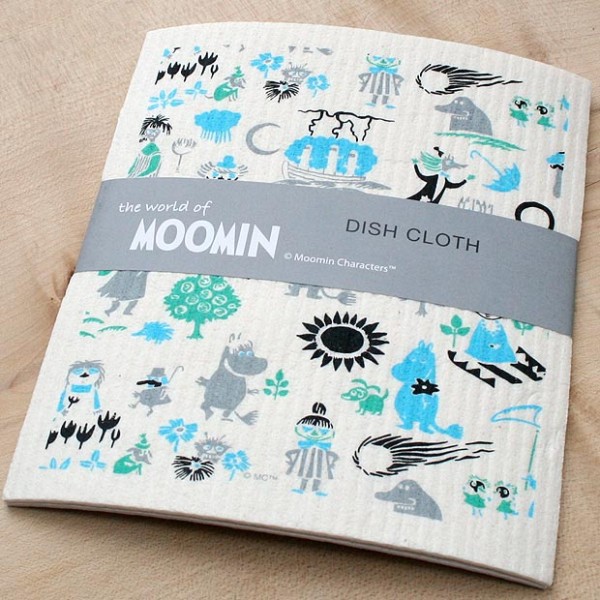
Moomin dishcloths! But not only Moomin dishcloths: they are plastic free Moomin dishcloths, made from cellulose material that can be washed and reused, and – when they can’t be washed any longer – can put in the compost bin. Genius! I am so going to buying some of these. My anti-plastic lifestyle just got a whole lot more stylish!
(Find Moomin at Waterstones)
Sunday, 22 May 2011
Like Minded People
 Isn't it lovely to meet people who are thinking about the same things as you are? Despite the prevalence of 'green' today, it's actually been a while since I really met anyone I could have a proper discussion with about the environment. I love my family and friends, absolutely, but 95% of them are hardened consumers. So: thank you Cape Farewell and Shortcourse/UK for introducing me to like-minded thinkers.
When I was invited to apply for Shortcourse/UK (see post below), I really wasn't sure what to expect. The launch evening, held at Newlyn Gallery, and with presentations by Sion Parkinson, Daro Montag and Nick Edwards, was intersting, but - to my mind - decidedly 'arty'. Now don't get me wrong, I'm all for arty stuff, I just find a lot of it to be beyond my understanding (or out of my zone of thinking, I guess), which means that I find it difficult to appreciate. But Shortcourse/UK sounded like such an interesting and unusual opportunity, I thought I'd apply for it anyway - and boy am I glad I did.
 The truth of the matter is that firstly, despite being a writer (or attempting to be one, anyway), I've never thought of myself as an artist; and secondly, I found it hard to see how artists could really make a difference to environmental issues. I enjoyed the first two expeditions with Shortcourse/UK, but coming home each evening I wasn't really sure if I'd learnt anything or gained anything. This weekend, however, was the third and final expedition, a two day trip to the Isles of Scilly, and it rather feels as if everything has now clicked into place.
The beauty of Cape Farewell is that it brings together scientists and artists, enabling the cross pollination of thoughts. It changes artists' thinking by more concisely introducing the science behing environmental concerns, and it changes scientists' thinking by introducing the art and the beauty and - essentially - the naturalness of the environments around us. I think that without my even really being aware of it, being surrounded by artists for the last two days has got me thinking in a distinctly more 'arty' way. And where two months ago I would have been somewhat sceptical about this, today I feel really excited about it and I'm really, really hoping I can hold onto this feeling.
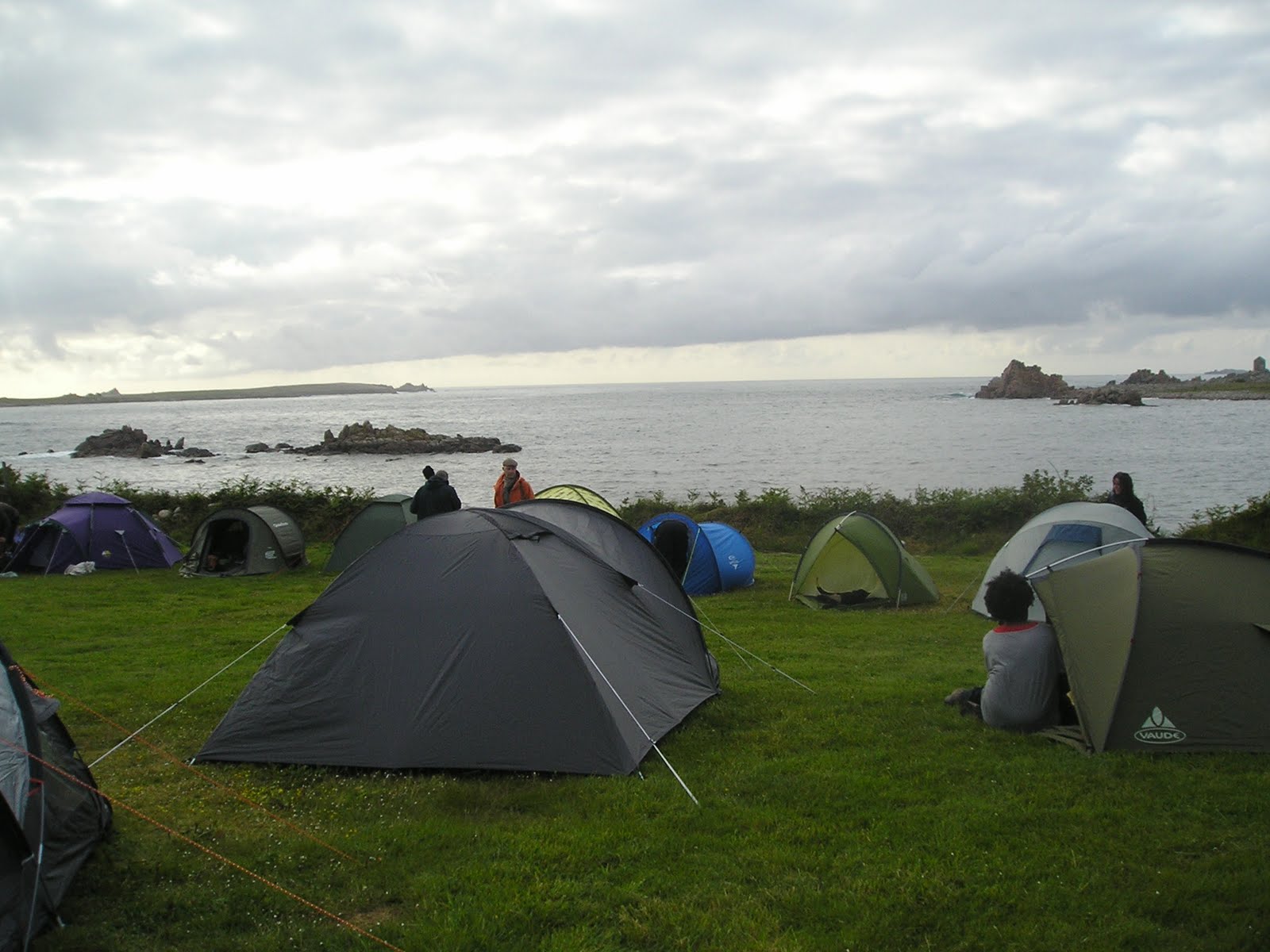 So what was so special about the Isles of Scilly expedition? Other than the Scillies being a pretty special place, it was immersion in the truest sense - immersion in the group of people I travelled with, immersion in the thinking and ideals of this group and its leaders, Sion and Daro, and immersion in the natural environment. After sleeping under canvas, right next to the sea, in a place with no light pollution, who wouldn't be thinking differently?
And as far as art and the environment goes, one of the best parts of the experience was listening to the presentations that the other students gave on their work, and discovering not only how art does communicate, but also how we're all like minded people. From Bryony, who is mid-way though a year rejecting consumerism, to Sonia's obsession with the sea, whales and plastic pollution, to Tom's research into the history of a field, generating some truly beautiful nature writing; Rob's investigation of ocean acidity, and Saffron, who is creating her own food range that highlights the absurdity of modern society's food attitudes. Each of them (and everyones else inthe group too) demonstrates that art and science do not have to be exclusive subjects. And I'm really looking forward to working with them more.


A bit of plastic here and there, but I couldn't find any nurdles (a good thing!). I imagine that the Islanders keepa close hold on the quality of their beaches. Interestingly, it seemed as if there was more glass than plastic around the beaches, though what that means, if anything, I don't know.
Sunday, 8 May 2011
Clay Country Plastic
I am very excited to have been given a place on a series of expeditions being organised by Cape Farewell. Called 'Shortcourse/UK' and run in conjunction with University College Falmouth and The Eden Project, it's described as "an initiative that looks to question and reform society’s notions of what art education can be". The general idea is to combine environmental and ecological thinking with art - thus using art and creative thinking to communicate ideas and issues about the environment and climate change.
I am by no means a photographer and only possess a standard digital camera, nothing fancy, but I thought I'd share some of the photos that I took on the first expedition on Friday. After starting at The Eden Project with an early morning sweat lodge ceremony, we then spent the rest of the day following the trails around the site in 'clay country' and thinking about the ecology of the landscape around us.
I spent most of the day thinking about the tug of war between man and nature, but the other thing that kept jumping out at me was the plastic rubbish. Now, as a tourist trail, I suppose this is inevitable, but none-the-less it served to remind me again of the plastic impact.


I am by no means a photographer and only possess a standard digital camera, nothing fancy, but I thought I'd share some of the photos that I took on the first expedition on Friday. After starting at The Eden Project with an early morning sweat lodge ceremony, we then spent the rest of the day following the trails around the site in 'clay country' and thinking about the ecology of the landscape around us.
I spent most of the day thinking about the tug of war between man and nature, but the other thing that kept jumping out at me was the plastic rubbish. Now, as a tourist trail, I suppose this is inevitable, but none-the-less it served to remind me again of the plastic impact.


Sunday, 17 April 2011
Make Do & Mend versus Consumerism
Needle and Thread
“If you get me a needle and thread I can fix it right now for you,” I say to my friend K.
We’re in her son’s bedroom, crouched over his cot mattress. The zip is broken, and the best idea Bron had for fixing the problem involved cutting a hole. Only a little hole, but a hole nonetheless.
K gives me a slightly blank look. Or is it a bemused one? “I don’t have a needle and thread,” she says.
Now it’s my turn for the blank look. “You don’t have needle and thread?” I respond, dumbly. I know K’s not one for recreational sewing, but: “How can you not have a needle and thread?”
“I don’t sew!” she says, “so why would I?”
“But what do you do if you need to mend something?”
“I don’t,” she says. “I throw it away.”
Okay, like I said, I know K’s not one for recreational sewing - a stark contrast to me, who has a whole linen chest full to overflowing with sewing stuff. But, a week after our exchange, I’m still dumbfounded. To not even have one of those teeny tiny sewing kits you get inside a Christmas cracker just sounds insane to me. Maybe she wouldn’t know how to fix a hole, but what if she has a button that needs sewing back on?
On Make-Do-and-Mend
Tidying out my sewing chest this afternoon, thinking about this, I realise that she simply must not have been brought up in the ‘make do and mend’ mind frame. I wasn’t particularly – at least, not compared to my mum’s post-war generation - but my mum always had a pile of mending waiting for her on the kitchen table, so I guess it's something I've always been aware of. If K's parents didn't think this way, then she wouldn't do either. Yeah, I definately can't picture her mum with a needle and thread. And her dad? Well, if there was such a thing as the Cornish mafia, I pretty sure he'd be part of it, and a needle and thread doesn't really sit with that either.
But mending is something I’ve started doing more of recently. Bad economy and all that. In the last three weeks I’ve patched holes in two pairs of jeans (one in the crotch, one in the knee), replaced a missing button on a favourite shirt, and fixed holes in three different t-shirts. Most of my favourite people at work are knitters or sew-ers and I’ve even witnessed my highly fashion-conscious friend S fixing holes in her clothes.
Start a new trend
So, how did the ability to use a needle and thread, or the need to keep one in the house, fall out of fashion? One word is all the answer I need: consumerism.
Why mend something when you can just replace it? Throw it away, get a new one! But: hello piles of rubbish, hello cheap goods that fall apart after six months of use, hello homes with no needle and thread. I couldn’t live without having a needle and thread in the house, not just for fixing things, but for my own pleasure too (no, not like that… for making patchwork quilts, silly!). I say: bring back make-do-and-mend! It should be the next big fashion craze. Make the most of your stuff before you chuck it and that means: spending less of your hard-earned money, plus less stuff going to the rubbish dump.
“If you get me a needle and thread I can fix it right now for you,” I say to my friend K.
We’re in her son’s bedroom, crouched over his cot mattress. The zip is broken, and the best idea Bron had for fixing the problem involved cutting a hole. Only a little hole, but a hole nonetheless.
K gives me a slightly blank look. Or is it a bemused one? “I don’t have a needle and thread,” she says.
Now it’s my turn for the blank look. “You don’t have needle and thread?” I respond, dumbly. I know K’s not one for recreational sewing, but: “How can you not have a needle and thread?”
“I don’t sew!” she says, “so why would I?”
“But what do you do if you need to mend something?”
“I don’t,” she says. “I throw it away.”
Okay, like I said, I know K’s not one for recreational sewing - a stark contrast to me, who has a whole linen chest full to overflowing with sewing stuff. But, a week after our exchange, I’m still dumbfounded. To not even have one of those teeny tiny sewing kits you get inside a Christmas cracker just sounds insane to me. Maybe she wouldn’t know how to fix a hole, but what if she has a button that needs sewing back on?
On Make-Do-and-Mend
Tidying out my sewing chest this afternoon, thinking about this, I realise that she simply must not have been brought up in the ‘make do and mend’ mind frame. I wasn’t particularly – at least, not compared to my mum’s post-war generation - but my mum always had a pile of mending waiting for her on the kitchen table, so I guess it's something I've always been aware of. If K's parents didn't think this way, then she wouldn't do either. Yeah, I definately can't picture her mum with a needle and thread. And her dad? Well, if there was such a thing as the Cornish mafia, I pretty sure he'd be part of it, and a needle and thread doesn't really sit with that either.
But mending is something I’ve started doing more of recently. Bad economy and all that. In the last three weeks I’ve patched holes in two pairs of jeans (one in the crotch, one in the knee), replaced a missing button on a favourite shirt, and fixed holes in three different t-shirts. Most of my favourite people at work are knitters or sew-ers and I’ve even witnessed my highly fashion-conscious friend S fixing holes in her clothes.
Start a new trend
So, how did the ability to use a needle and thread, or the need to keep one in the house, fall out of fashion? One word is all the answer I need: consumerism.
Why mend something when you can just replace it? Throw it away, get a new one! But: hello piles of rubbish, hello cheap goods that fall apart after six months of use, hello homes with no needle and thread. I couldn’t live without having a needle and thread in the house, not just for fixing things, but for my own pleasure too (no, not like that… for making patchwork quilts, silly!). I say: bring back make-do-and-mend! It should be the next big fashion craze. Make the most of your stuff before you chuck it and that means: spending less of your hard-earned money, plus less stuff going to the rubbish dump.
Sunday, 27 March 2011
A Life Less Plastic
Reading the email from my tutor made my heart sink and my frustration levels rise.
January 2011 and the deadline for the final submission for my MA is looming. The email tells me I have to hand in two hard copies of my final project, properly bound.
So what's the problem? Over the last two years I've gotten away with handing my coursework in simply tied together with interesting pieces of ribbon, but something tells me that's just not going to cut it this time around. Properly bound is all well and good, but it usually means a plastic binding comb to keep all the pages together, coupled with acetate covers. Which seems rather hypocritical given that my final project is all about quitting plastic.
There are always ways around these little problems though (well, nearly always; I still haven't solved half the problems I've got when it comes to plastic food packaging, but hey, that's a different story). A quick email to KallKwik revealed that they can bind manuscripts using a metal comb if I want, rather than a plastic one. For a few extra pennies, of course.
Well, I thought, that's a start. So when I finally got all my pages together I toddled down there - and then convinced them to not use the acetate covers. Instead, the very helpful lady photocopied my title page onto a piece of card to act as the front cover instead of using the ubiquitous plastic. Although I think she thought I was a little odd. Why wouldn't I want a nice shiney acetate cover?
And now I've finally gotten around to updating my website, where you can read the introduction to my project, A Life Less Plastic. Next stage in my grand plan to conquer the world: win over an agent and start writing chapter six.
January 2011 and the deadline for the final submission for my MA is looming. The email tells me I have to hand in two hard copies of my final project, properly bound.
So what's the problem? Over the last two years I've gotten away with handing my coursework in simply tied together with interesting pieces of ribbon, but something tells me that's just not going to cut it this time around. Properly bound is all well and good, but it usually means a plastic binding comb to keep all the pages together, coupled with acetate covers. Which seems rather hypocritical given that my final project is all about quitting plastic.
There are always ways around these little problems though (well, nearly always; I still haven't solved half the problems I've got when it comes to plastic food packaging, but hey, that's a different story). A quick email to KallKwik revealed that they can bind manuscripts using a metal comb if I want, rather than a plastic one. For a few extra pennies, of course.
Well, I thought, that's a start. So when I finally got all my pages together I toddled down there - and then convinced them to not use the acetate covers. Instead, the very helpful lady photocopied my title page onto a piece of card to act as the front cover instead of using the ubiquitous plastic. Although I think she thought I was a little odd. Why wouldn't I want a nice shiney acetate cover?
And now I've finally gotten around to updating my website, where you can read the introduction to my project, A Life Less Plastic. Next stage in my grand plan to conquer the world: win over an agent and start writing chapter six.
Friday, 4 March 2011
Fictional Plastics
In honour of Saturday's World Book Night, I thought I’d write a post about books. Alright, I admit it, I’ll jump at any excuse to talk about books. The challenge is to link books to plastic…
 So I’ve just been reading The Windup Girl by Paolo Bacigalupi. It’s set in a future dystopian world which is essentially controlled by – surprise, surprise – American multinational corporations. At some point there was worldwide economic collapse and it seems that, in an attempt to regain control, two or three companies created a set of plagues that wiped out virtually all plant life around the world. Then, these companies kindly stepped into the breach with their genetically-engineered plague-resistant plants, saving the starving nations – at a price, of course.
At its heart, The Windup Girl is about politics and corruption, about what is right and wrong, and the grey areas in between. But it’s also very much about the environment and how humans manipulate and destroy it for their own needs. It has many lessons to teach. And the plastic? Well, this is a world where oil no long reins. No oil, no plastic. Well, except for cellulose-based plastic.
In short, The Windup Girl is environmental fiction at its best. Look for it in the Science fiction section of your local bookstore. Oh yes, on a book-geek note: the science fiction section? Why are some environmental fiction titles pegged into this genre when they are of equal literary value as those more commonly classified as fiction? I’m thinking J. G. Ballard (The Drowned World), Margaret Atwood (Oryx and Crake), Ian McEwan (Solar). Paolo Bacigalupi deserves to be considered with this stock too.
Anyway, pop out to your local Waterstone’s tomorrow night and you should find it open. And if you’re really lucky there’ll be someone there giving out free books. Unfortunately not Paolo Bacigalupi, though. Maybe next year?
 So I’ve just been reading The Windup Girl by Paolo Bacigalupi. It’s set in a future dystopian world which is essentially controlled by – surprise, surprise – American multinational corporations. At some point there was worldwide economic collapse and it seems that, in an attempt to regain control, two or three companies created a set of plagues that wiped out virtually all plant life around the world. Then, these companies kindly stepped into the breach with their genetically-engineered plague-resistant plants, saving the starving nations – at a price, of course.
 At its heart, The Windup Girl is about politics and corruption, about what is right and wrong, and the grey areas in between. But it’s also very much about the environment and how humans manipulate and destroy it for their own needs. It has many lessons to teach. And the plastic? Well, this is a world where oil no long reins. No oil, no plastic. Well, except for cellulose-based plastic.
In short, The Windup Girl is environmental fiction at its best. Look for it in the Science fiction section of your local bookstore. Oh yes, on a book-geek note: the science fiction section? Why are some environmental fiction titles pegged into this genre when they are of equal literary value as those more commonly classified as fiction? I’m thinking J. G. Ballard (The Drowned World), Margaret Atwood (Oryx and Crake), Ian McEwan (Solar). Paolo Bacigalupi deserves to be considered with this stock too.
Anyway, pop out to your local Waterstone’s tomorrow night and you should find it open. And if you’re really lucky there’ll be someone there giving out free books. Unfortunately not Paolo Bacigalupi, though. Maybe next year?
Subscribe to:
Posts (Atom)