Sunday, 8 May 2011

Clay Country Plastic

I am very excited to have been given a place on a series of expeditions being organised by Cape Farewell. Called 'Shortcourse/UK' and run in conjunction with University College Falmouth and The Eden Project, it's described as "an initiative that looks to question and reform society’s notions of what art education can be". The general idea is to combine environmental and ecological thinking with art - thus using art and creative thinking to communicate ideas and issues about the environment and climate change.

I am by no means a photographer and only possess a standard digital camera, nothing fancy, but I thought I'd share some of the photos that I took on the first expedition on Friday. After starting at The Eden Project with an early morning sweat lodge ceremony, we then spent the rest of the day following the trails around the site in 'clay country' and thinking about the ecology of the landscape around us.

I spent most of the day thinking about the tug of war between man and nature, but the other thing that kept jumping out at me was the plastic rubbish. Now, as a tourist trail, I suppose this is inevitable, but none-the-less it served to remind me again of the plastic impact.


Sunday, 17 April 2011

Make Do & Mend versus Consumerism

Needle and Thread
“If you get me a needle and thread I can fix it right now for you,” I say to my friend K.

We’re in her son’s bedroom, crouched over his cot mattress. The zip is broken, and the best idea Bron had for fixing the problem involved cutting a hole. Only a little hole, but a hole nonetheless.

K gives me a slightly blank look. Or is it a bemused one? “I don’t have a needle and thread,” she says.

Now it’s my turn for the blank look. “You don’t have needle and thread?” I respond, dumbly. I know K’s not one for recreational sewing, but: “How can you not have a needle and thread?”

“I don’t sew!” she says, “so why would I?”

“But what do you do if you need to mend something?”

“I don’t,” she says. “I throw it away.”

Okay, like I said, I know K’s not one for recreational sewing - a stark contrast to me, who has a whole linen chest full to overflowing with sewing stuff. But, a week after our exchange, I’m still dumbfounded. To not even have one of those teeny tiny sewing kits you get inside a Christmas cracker just sounds insane to me. Maybe she wouldn’t know how to fix a hole, but what if she has a button that needs sewing back on?

On Make-Do-and-Mend
Tidying out my sewing chest this afternoon, thinking about this, I realise that she simply must not have been brought up in the ‘make do and mend’ mind frame. I wasn’t particularly – at least, not compared to my mum’s post-war generation - but my mum always had a pile of mending waiting for her on the kitchen table, so I guess it's something I've always been aware of. If K's parents didn't think this way, then she wouldn't do either. Yeah, I definately can't picture her mum with a needle and thread. And her dad? Well, if there was such a thing as the Cornish mafia, I pretty sure he'd be part of it, and a needle and thread doesn't really sit with that either.

But mending is something I’ve started doing more of recently. Bad economy and all that. In the last three weeks I’ve patched holes in two pairs of jeans (one in the crotch, one in the knee), replaced a missing button on a favourite shirt, and fixed holes in three different t-shirts. Most of my favourite people at work are knitters or sew-ers and I’ve even witnessed my highly fashion-conscious friend S fixing holes in her clothes.

Start a new trend
So, how did the ability to use a needle and thread, or the need to keep one in the house, fall out of fashion? One word is all the answer I need: consumerism.

Why mend something when you can just replace it? Throw it away, get a new one! But: hello piles of rubbish, hello cheap goods that fall apart after six months of use, hello homes with no needle and thread. I couldn’t live without having a needle and thread in the house, not just for fixing things, but for my own pleasure too (no, not like that… for making patchwork quilts, silly!). I say: bring back make-do-and-mend! It should be the next big fashion craze. Make the most of your stuff before you chuck it and that means: spending less of your hard-earned money, plus less stuff going to the rubbish dump.

Sunday, 27 March 2011

A Life Less Plastic

Reading the email from my tutor made my heart sink and my frustration levels rise.

January 2011 and the deadline for the final submission for my MA is looming. The email tells me I have to hand in two hard copies of my final project, properly bound.

So what's the problem? Over the last two years I've gotten away with handing my coursework in simply tied together with interesting pieces of ribbon, but something tells me that's just not going to cut it this time around. Properly bound is all well and good, but it usually means a plastic binding comb to keep all the pages together, coupled with acetate covers. Which seems rather hypocritical given that my final project is all about quitting plastic.

There are always ways around these little problems though (well, nearly always; I still haven't solved half the problems I've got when it comes to plastic food packaging, but hey, that's a different story). A quick email to KallKwik revealed that they can bind manuscripts using a metal comb if I want, rather than a plastic one. For a few extra pennies, of course.

Well, I thought, that's a start. So when I finally got all my pages together I toddled down there - and then convinced them to not use the acetate covers. Instead, the very helpful lady photocopied my title page onto a piece of card to act as the front cover instead of using the ubiquitous plastic. Although I think she thought I was a little odd. Why wouldn't I want a nice shiney acetate cover?

And now I've finally gotten around to updating my website, where you can read the introduction to my project, A Life Less Plastic. Next stage in my grand plan to conquer the world: win over an agent and start writing chapter six.

Friday, 4 March 2011

Fictional Plastics

In honour of Saturday's World Book Night, I thought I’d write a post about books. Alright, I admit it, I’ll jump at any excuse to talk about books. The challenge is to link books to plastic…

So I’ve just been reading The Windup Girl by Paolo Bacigalupi. It’s set in a future dystopian world which is essentially controlled by – surprise, surprise – American multinational corporations. At some point there was worldwide economic collapse and it seems that, in an attempt to regain control, two or three companies created a set of plagues that wiped out virtually all plant life around the world. Then, these companies kindly stepped into the breach with their genetically-engineered plague-resistant plants, saving the starving nations – at a price, of course.

At its heart, The Windup Girl is about politics and corruption, about what is right and wrong, and the grey areas in between. But it’s also very much about the environment and how humans manipulate and destroy it for their own needs. It has many lessons to teach. And the plastic? Well, this is a world where oil no long reins. No oil, no plastic. Well, except for cellulose-based plastic.

In short, The Windup Girl is environmental fiction at its best. Look for it in the Science fiction section of your local bookstore. Oh yes, on a book-geek note: the science fiction section? Why are some environmental fiction titles pegged into this genre when they are of equal literary value as those more commonly classified as fiction? I’m thinking J. G. Ballard (The Drowned World), Margaret Atwood (Oryx and Crake), Ian McEwan (Solar). Paolo Bacigalupi deserves to be considered with this stock too.

Anyway, pop out to your local Waterstone’s tomorrow night and you should find it open. And if you’re really lucky there’ll be someone there giving out free books. Unfortunately not Paolo Bacigalupi, though. Maybe next year?

Sunday, 27 February 2011

The Gift Cards that Don't Keep Giving...

I’m trying to remember the last time I bought or was given a paper gift voucher. Other than the £3 voucher I had courtesy of my Marks & Spencer credit card a few days ago, I honestly can’t remember. We get the odd Bonus Bond or High Street Voucher come through the tills at work, but these are, I feel, rather the exception today. National Book Tokens went electronic a year ago, and even the High Street Voucher company is producing a gift card version of the ‘old style’ paper voucher. I don’t have anything against electronic gift cards, per se, except for the obvious: They’re all plastic. It brings whole new meaning to the term paying by plastic.

The experiment
I’ve been running the cash office at work over the last ten days or so. A recent new rule introduced by our beloved auditor is that, instead of chucking them straight into the bin, any empty gift cards we’re left with at the tills go into the drawer to be destroyed in the cash office. The consequence? Suddenly there’s a clear trail highlighting the number of gift cards moving through the store.

Day one. I begin my cash office reign by cutting up each gift card as I lay hands on it. It seems like the quickest solution. Done and dusted.

Day two. Ditto.

Day three. I’m starting to wonder about the number of gift cards going through my fingers. There’s a little carpet of them forming in the bin at my feet. We’re quite a big store, spread over two floors, with eight tills. I guess four or five cards come out of each till, sometimes more, sometimes less.

Day four. It’s Monday and I’m cashing up the takings from Saturday 19th. Saturdays are always busier and there’s quite a handful of gift cards in the first till drawer, so out of pure laziness I decide to chuck them in a handy box that’s been left on the desk and then cut them all up in one go at the end. I cash up Sunday’s takings as well, adding more cards to the box. It’s quite full. Plastic that has no purpose other than to be used up and chucked in the bin. Immediately I start to wonder how many cards I could collect over a week.

Final tally
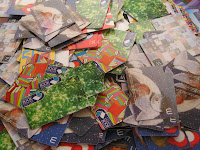
Number of cards collected over a seven day period (Saturday 19th February to Friday 25th): 317
Total weight of plastic collected: 1kg 529g (or 3lb 6oz)
Average number of cards per day: 45
Average number of cards per till: 39


Of course, the week in question covers half term, so it could be said that as a result, more cards might have been collected this week than on a week during term time.

The Gift Card Policy
Why electronic gift cards? Why have businesses changed from paper to plastic? There are lots of financial benefits to a company for producing gift vouchers, whether paper or plastic. When it comes to plastic, though, I think it’s generally favoured because:

. Money has to be ‘uploaded’ onto them. Before this is done, they essentially have no value, which means that if a box goes lost in the post, no money is lost.

. Retailers don’t have to issue change on them. With a £10 paper voucher, if a customer spends £9.99 the retailer is expected to give 1p change. With the gift card, that 1p remains on the card for the consumer to use again. But how often does this happen? Most of the people I serve say it’s not worth them holding onto the card for just a penny – ‘go ahead and destroy it’ they tell me, probably not realising that means the company gets to add that penny to it’s coffers. 1p may not make much difference on its own, but add up all those pennies and that’s a nice little bit of extra profit for the company.

. As every gift card has its own unique identification number, the cards are trackable.

. They are re-usable. Consumers can top them up and pass them on to friends and family as many times as they want, in comparison to paper vouchers which can only be used once. But how often do they get passed on? I have no official statistics to back me up, but considering the number of cards I’ve had to put in the waste this week alone, I’m confident in saying very few people. Actually, in the same seven days that I collected my cards, my store sold 140 new gift cards and only 9 top-ups. So, this week at least, just 6% of gift cards sold are being re-used. That means we’re sending 94% to the rubbish dump.

The Gift Card Legacy
Electronic gift cards represent another form of what I often think of as ‘hidden’ plastic. They’re so common today that little thought goes into their everyday usage. Customers who rail about plastic bags don’t give a thought to asking me to chuck their gift card in the bin. The company I work for, Waterstone’s Booksellers, say they can’t recycle them because – if I remember correctly (please do correct me if I’m wrong) - the magnetic strips contain confidential information, though I’m far from clear on the why’s and how’s of what exactly this confidential information is. Plus it’s ok for me to just cut them up and throw them in the bin? I know I’m not the only who’s thinking about the problem because at meetings I’ve been to, the question of recycling has been asked by others. So how can we change attitudes?

Recycling gift cards IS an option, despite other’s claims (read this article!). But: I remain adamant that, ultimately, recycling is not a solution to the plastic problem, only a stop-gap. The only real solution is stop using plastic altogether.

Which leaves me with two thoughts:
1. Don't buy electronic gift cards anymore!
2. For those companies who choose not to recycle the gift cards they recieve back, what else can be done with them?

"Stick 'em together to make bricks," Bron says. "And then build a house!"

NB. Covering My Ass
Please note that this blog posting is not a criticism of the company I work for, which has an excellent environmental policy. Rather, it is designed to highlight the high volume waste problem that electronic gift cards represent, and is a call for the retail industry as a whole to reconsider their practices. Please also note that following their collection, I destroyed each and every one of the gift cards by cutting them in half and putting them in the bin, as company policy requires. And yes, my hand hurts.

Friday, 25 February 2011

Thanks M&S

This is what dreams are made of. Hot Chocolate Fudge Pudding. Mmmm.


Thank you Marks & Spencer for:
1. Sending me £3 worth of vouchers for me to go and treat myself.
2. Making Hot Chocolate Fudge Pudding in the first place.
3. Packaging it so nicely and packaging it so simply. Cardboard box and a foil tray.

It can be done! Look, Marks & Spencer have done it. Packaging with no plastic. And the food survived! I would say it’s like some kind of miracle, except for the part where it’s not. If there’s a miracle involved here at all, it’s only in the fact that plastic-free packaging for a rich and sticky pudding has been attempted. I applaud you, M&S. But maybe now you could try applying this basic principle to the rest of your range? The hot chocolate fudge pudding was, unfortunately, the only plastic-free pudding I could find anywhere in your store…

More please.

Sunday, 16 January 2011

On Absences

Reasons for the recent complete lack of blogging…

1. I am a Christmas humbug. Actually, that’s not true, I love Christmas, but I hate what retail and working in retail does to Christmas. It’s blimmin’ hard work, it makes me grumpy, and it’s hard to think about much outside of it.

2. In order to try and hold true to my earlier resolve to achieve a less plastic Christmas this year, most of my December evenings and days off were dedicated to hand-making a selection of Christmas gifts.

3. One poorly sick cat who, after falling off the sofa one evening in the middle of December because she couldn’t breathe, spent a week at the kitten hospital being prodded and poked to try and find out what was wrong with her. And as Bron and I have no human children, the Dora-cat is our baby, so we were a bit upset.

4. The problem with working full time whilst studying for an MA, trying to change your lifestyle, and trying to write a book about it, is that when you stop for what is ostensibly going to be just a couple of weeks, it’s really hard to get started again. And once you let one little bit of plastic in because you’re tired and stressed and upset about your cat, a lot more tends to follow, so I’ve been feeling a bit shameful about my efforts (or lack thereof) of late.

But… with my MA deadline looming (less than two weeks to submit the first six chapters of my book – aaarrghhh!) I am back in the saddle and ready to go. So watch this space, and I’ll try to be a bit prompter and more reliable in the coming weeks.

P.S. Praise be to pet insurance. It is sooo worth it.