'In, out, in out, shake it all about; you do the hokey kokey, and you turn around... that's what it's all about." At least, that's how its seemed to me lately. Come Wednesday I will have moved house three times in five months: to the parents, to a house-share (complete with falling down the stairs and tearing ligaments in my foot), and now back to the parents again. Can I get back to my normal life now please?
But, after a winter of little activity (other than endless packing, unpacking and deliberation over whether or not I really need this book as well as all the others), I am very excited to be part of an art exhibition at the Eden Project this Easter. I never thought of myself as an artist before, but attending SHORTCOURSE/UK Cornwall last year gave me such a brilliant immersion experience that it's completely changed my world view. The exhibition is called Hevva! Hevva! and is running 2nd to 12th April in collaboration with Cape Farewell and Eden's Bi-ot'ik programme.
If you're in the area, check it out! The other artists who are contributing are all environmentally minded and have beautiful, thoughtful work. It should be a great exhibition.
As far as plastic is concerned, I'm hoping to show my plastic patchwork - made from Quality Street wrappers that I collected over Christmas (with a little help from my parents!). I say 'hoping' because at this particular point in time I have no idea how my first attempt at 'art' will compare to that of my fellow students'...
Sunday, 11 March 2012

Sunday, 27 November 2011
Voyage of a Lifetime
It's nice to know the boy still thinks of me. The following is a direct copy of a book review which Bron saved for me from The New Scientist. The book in question is Plastic Ocean: How a sea captain's chance discovery launched a determined quest to save the oceans, and recounts Captain Charles Moore's experiences of sailing the high plastic seas.
NB. The review was published on page 55 of the New Scientist on 29 October 2011. It is written by Bob Holmes.
Dangerous debris
NB. The review was published on page 55 of the New Scientist on 29 October 2011. It is written by Bob Holmes.
Dangerous debris
When Charles Moore sailed his 50-foot catamaran Alguita through one of the remotest, least-visuted parts of the Pacific Ocean in 1997, he was appalled to find plastic flotsam everywhere.
This discovery of what has come to be called the Great Pacific Garbage Patch - a vast area of the central Pacific where debris accumulates because of ocean current patterns - set Moore off on a crusade to measure, identify and, ultimately, try to prevent plastic pollution of the ocean. A decade and a half later, Moore's obsession has led to several scientific papers, documentary films, numerous media appearances, and now a book.
"I wasn't the first to be disturbed about plastic trash in the ocean, and I wasn't the first to study it," he writes in Plastic Ocean. "But maybe I was the first to freak out about it."
And freak out he certainly did. Chapter by chapter, Moore recounts his growing alarm as he learns about the abundance of plastic debris in the ocean and the ways it can get there. He also documents the clear harm that seabirds and marine mammals suffer when they become tangled in abandoned fishing nets or swallow balloons or plastic bags. And he makes a tentative case that even the smallest shards of plastic - the size and shape of plankton, and thus likely to be a eaten by fish and other planktivores - may carry a payload of toxic chemicals into the food chain.
In the end, though, many readers - especially New Scientist readers - are likely to find Moore unpersuasive. Partly that's because his book is a bit of a mess, rambling and disorganised. But the biggest problem is that Plastic Ocean comes across as a bit of a rant.
By his own account, Moore decided that plastic flotsam is a Very Bad Thing long before he gathered any solid evidence of any harm to sea life. And he is prone to making leaps: just because toxins can be detected in plastics does not mean that they are present in biologically meaningful doses. Moore my very well be right in thinking they are, but readers who are looking for a dispassionate conclusion based on the facts won't find it here.
The Other View
The Other View
Truth be told, I had only read half of this review before I began copying it. So, when I got to the penultimate paragraph I started to have doubts as to whether I should post it or not. But, leap taker or not, Moore's book is surely going to be an interesting read. A shame that, as suggested by Holmes, it may not create many new converts to the plastic cause, but even if it creates one then that is one more person fighting in what I consider to be the right corner.
Two other books on the plastic problem have also been published this year, if anyone wishes to add them to their Christmas list. Firstly, Plastic: A Toxic Love Story by Susan Freinkel was published earlier this year - a copy is currently sitting on my bookshop waiting patiently to be read. Or for what looks like a lighter read there is David de Rothschild's Plastiki: Across the Pacific on plastic: An adventure to save our oceans. I'm eager to get a closer look at this as I love the website based on the Plastiki's expeditions.
Two other books on the plastic problem have also been published this year, if anyone wishes to add them to their Christmas list. Firstly, Plastic: A Toxic Love Story by Susan Freinkel was published earlier this year - a copy is currently sitting on my bookshop waiting patiently to be read. Or for what looks like a lighter read there is David de Rothschild's Plastiki: Across the Pacific on plastic: An adventure to save our oceans. I'm eager to get a closer look at this as I love the website based on the Plastiki's expeditions.
The Parent Trap
How does a girl persuade her mum to stop trying to make her throw stuff away?
Since moving out of my shared house with Bron, I've been having a bit of purge. While this is a good thing (I hope) for the charity shops, and for me, it's been an equally bad thing for the state of landfill. The amazing Mrs. Green over on the My Zero Waste blog would surely have a heart attack if she saw the things I've been recklessly throwing "away" of late. For the most part I'm talking small things, out of date medicines I found in the back of the cupboard, an ancient video tape or two, stuff like that, and stuff that I can't even remember now that I sit here trying to remember.
The worst stuff, though, the worst stuff are those things that you need when you have a house of your own, but when you move into another household, as Bron and I have both just done, he to share with a bachelor friend and myself to the alma mater. This is the stuff that neither of you wants right now, but are left with the question: what to do with it in the meantime? Stuff like two plastic waste bins, one from the kitchen, one from the bathroom. Two old tires that came off my car that I'd saved because I had this cunning idea that they could be used as garden planters. A microwave that's going rusty on the inside; ditto with a toaster. A bag full of plastic bags that - even when you don't accept plastic bags from shops - somehow worm their way into your home.
Mix this with:
(a) a set of parents who have unconsciously embraced the modern lifestyle of 'out with the old and in with the new', and
(b) a girl who really doesn't want to deal with the reality of dismantling her home,
...and you get a big trip to the local dump.
I watched those two perfectly good dustbins ("a charity shop doesn't want stuff like like that" and, "I'll buy you a new one", instructed my mum) go sailing over the rails and into the skip - there to sit for all eternity alongside all the other household items the local Cornish folk had gotten bored of this week. It felt so horribly wrong. But (yes, here it is, that 'but') they needed to be out of the house that day, there was/is no space left in my storage rental, and no more space at the parental home for them either. Although it felt wrong, I also felt like I had no other option at that particular moment in time. A word to the wise: never try to clear house from 40 miles away; this is what happens. And where was Bron? Well he, of course, had moved out all the stuff he wanted and left me, in typical Bron-stylee, to deal with the rest of it.
But back to my opening question. Despite the episode with the bins, I managed to save the draining racks from the kitchen sink. Or so I thought...
"I just can't get this clean," my mum tells me while I'm drinking my morning cup of tea. She's trying to clean off the natural accumulation of gunk that any draining rack gets after several years of use (honestly, I have cleaned it since I bought it, just clearly not to my mother's standards).
"That's ok," I said, "You don't have to clean it."
"But its unhygienic. It'll grow bacteria if you put it away like this."
"It's fine, it'll be fine."
"Let's just get rid of it. I'll buy you a new one." Ah, bless her. She absolutely means well. And yes, a new one would be nice. But that's not the point: there's nothing wrong with the old one. It's perfectly usable. And there really isn't that much gunk.
The final word? In this instance, mine. "It hasn't given me food poisoning yet," I commented. To which she, reluctantly, conceded.
The irony in all this is the fact that both of my parents grew up in a time when 'make do and mend' was the daily mantra. My mum comes from a low income background where nothing was wasted. In many ways she's still very much a proponent of this attitude, but - as far as I can tell - only so far as hygiene is not involved. Bacteria be damned if my mum is in the room.
Since moving out of my shared house with Bron, I've been having a bit of purge. While this is a good thing (I hope) for the charity shops, and for me, it's been an equally bad thing for the state of landfill. The amazing Mrs. Green over on the My Zero Waste blog would surely have a heart attack if she saw the things I've been recklessly throwing "away" of late. For the most part I'm talking small things, out of date medicines I found in the back of the cupboard, an ancient video tape or two, stuff like that, and stuff that I can't even remember now that I sit here trying to remember.
The worst stuff, though, the worst stuff are those things that you need when you have a house of your own, but when you move into another household, as Bron and I have both just done, he to share with a bachelor friend and myself to the alma mater. This is the stuff that neither of you wants right now, but are left with the question: what to do with it in the meantime? Stuff like two plastic waste bins, one from the kitchen, one from the bathroom. Two old tires that came off my car that I'd saved because I had this cunning idea that they could be used as garden planters. A microwave that's going rusty on the inside; ditto with a toaster. A bag full of plastic bags that - even when you don't accept plastic bags from shops - somehow worm their way into your home.
Mix this with:
(a) a set of parents who have unconsciously embraced the modern lifestyle of 'out with the old and in with the new', and
(b) a girl who really doesn't want to deal with the reality of dismantling her home,
...and you get a big trip to the local dump.
I watched those two perfectly good dustbins ("a charity shop doesn't want stuff like like that" and, "I'll buy you a new one", instructed my mum) go sailing over the rails and into the skip - there to sit for all eternity alongside all the other household items the local Cornish folk had gotten bored of this week. It felt so horribly wrong. But (yes, here it is, that 'but') they needed to be out of the house that day, there was/is no space left in my storage rental, and no more space at the parental home for them either. Although it felt wrong, I also felt like I had no other option at that particular moment in time. A word to the wise: never try to clear house from 40 miles away; this is what happens. And where was Bron? Well he, of course, had moved out all the stuff he wanted and left me, in typical Bron-stylee, to deal with the rest of it.
But back to my opening question. Despite the episode with the bins, I managed to save the draining racks from the kitchen sink. Or so I thought...
"I just can't get this clean," my mum tells me while I'm drinking my morning cup of tea. She's trying to clean off the natural accumulation of gunk that any draining rack gets after several years of use (honestly, I have cleaned it since I bought it, just clearly not to my mother's standards).
"That's ok," I said, "You don't have to clean it."
"But its unhygienic. It'll grow bacteria if you put it away like this."
"It's fine, it'll be fine."
"Let's just get rid of it. I'll buy you a new one." Ah, bless her. She absolutely means well. And yes, a new one would be nice. But that's not the point: there's nothing wrong with the old one. It's perfectly usable. And there really isn't that much gunk.
The final word? In this instance, mine. "It hasn't given me food poisoning yet," I commented. To which she, reluctantly, conceded.
The irony in all this is the fact that both of my parents grew up in a time when 'make do and mend' was the daily mantra. My mum comes from a low income background where nothing was wasted. In many ways she's still very much a proponent of this attitude, but - as far as I can tell - only so far as hygiene is not involved. Bacteria be damned if my mum is in the room.
Tuesday, 15 November 2011
Plastic Living
People keep asking me: “How’s the writing going?”
To which my brain responds: Sorry, err, what writing?
After all, how can I write about trying to live without plastic when I haven’t been trying particularly hard to do the actual living without plastic part?
“Shock! Horror!”
To which my brain responds: Sorry, err, what writing?
After all, how can I write about trying to live without plastic when I haven’t been trying particularly hard to do the actual living without plastic part?
“Shock! Horror!”
Or so readers may say. “You’ve stopped watching your plastic intake? How could you?”
I haven’t actually stopped watching my plastic intake so much as watched it increase instead of decrease. I could say that I don’t know how it happened, but the truth is I do know. And there are two main reasons - whether they are good reasons or not, I don’t know, but they are my reasons.
1. I’m lazy and I like yummy things to eat. Most of the plastic in my life comes from food - takeaway sandwiches, yogurt, ice cream. Things that I gave up a couple of years ago have crept back into my diet (and, unfortunately, onto my waistline). And when I’m on my lunch break and I’m hungry and I have half an hour to consume enough food to get me through the rest of the day, popping to M&S for a salad or sandwich is quick and easy.
2. Boyfriends are difficult. When I first started my plastic kick, Bron was completely supportive. But, whether he intended it or not, there are, unfortunately, limits to his support. Mostly in the form of whether or not a change I want to make impacts on him and his lifestyle, his habits. And when you live with someone, there is only so far you can go before everything you do impacts on the other person.
Catch 22.
When someone is resistant to change, do you:
(a) try to force the change you want on that person and risk making them either unhappy or resent you for forcing them into something they don’t want? Or,
(b) try to appease them, to maintain the status quo. The risk here being that you wind up resenting them from preventing you from being the person you want to be.
Thus, after two years of studying for my MA and a year plus of that trying to significantly reduce the amount of plastic coming into our house, I was well aware that Bron was reaching the limits of what he deemed acceptable change. Solution: give it a break, have a treat or two, and stop trying to change his plastic habits. I - perhaps rather blindly - hoped that this would go some way to solving the little cracks I worried were forming under the surface of our relationship. Of course, the problem with relaxing a bit on the plastic front is that ‘a bit’ leads to a bit more, and then a little bit more again. I wouldn’t go so far as to say that the plastic floodgates had opened, rather that they developed a bit of a leak. So how could I continue to write a blog about reducing plastic?
Unpredicatability
And now? Well, now everything is different. Those relationship cracks I mentioned? The act of not talking about plastic every day doesn’t actually act like polyfiller, no matter how much you wish it could. Especially when each crack needs a different type of polyfiller. And so, after five plus years of living with Bron, I now find myself back at my parents’ house.
You never can tell where life will take you. And the irony? If I thought Bron was hard to ‘train’ in the art of not buying plastic, my parents (as much as I love them, and as much as they are totally spoiling me right now) are a whole different level...
I haven’t actually stopped watching my plastic intake so much as watched it increase instead of decrease. I could say that I don’t know how it happened, but the truth is I do know. And there are two main reasons - whether they are good reasons or not, I don’t know, but they are my reasons.
1. I’m lazy and I like yummy things to eat. Most of the plastic in my life comes from food - takeaway sandwiches, yogurt, ice cream. Things that I gave up a couple of years ago have crept back into my diet (and, unfortunately, onto my waistline). And when I’m on my lunch break and I’m hungry and I have half an hour to consume enough food to get me through the rest of the day, popping to M&S for a salad or sandwich is quick and easy.
2. Boyfriends are difficult. When I first started my plastic kick, Bron was completely supportive. But, whether he intended it or not, there are, unfortunately, limits to his support. Mostly in the form of whether or not a change I want to make impacts on him and his lifestyle, his habits. And when you live with someone, there is only so far you can go before everything you do impacts on the other person.
Catch 22.
When someone is resistant to change, do you:
(a) try to force the change you want on that person and risk making them either unhappy or resent you for forcing them into something they don’t want? Or,
(b) try to appease them, to maintain the status quo. The risk here being that you wind up resenting them from preventing you from being the person you want to be.
Thus, after two years of studying for my MA and a year plus of that trying to significantly reduce the amount of plastic coming into our house, I was well aware that Bron was reaching the limits of what he deemed acceptable change. Solution: give it a break, have a treat or two, and stop trying to change his plastic habits. I - perhaps rather blindly - hoped that this would go some way to solving the little cracks I worried were forming under the surface of our relationship. Of course, the problem with relaxing a bit on the plastic front is that ‘a bit’ leads to a bit more, and then a little bit more again. I wouldn’t go so far as to say that the plastic floodgates had opened, rather that they developed a bit of a leak. So how could I continue to write a blog about reducing plastic?
Unpredicatability
And now? Well, now everything is different. Those relationship cracks I mentioned? The act of not talking about plastic every day doesn’t actually act like polyfiller, no matter how much you wish it could. Especially when each crack needs a different type of polyfiller. And so, after five plus years of living with Bron, I now find myself back at my parents’ house.
You never can tell where life will take you. And the irony? If I thought Bron was hard to ‘train’ in the art of not buying plastic, my parents (as much as I love them, and as much as they are totally spoiling me right now) are a whole different level...
Welcome to 'A Life Less Plastic', stage 2.
Sunday, 9 October 2011
Moomin Glory
My heart goes out to anyone who has never heard of the Moomins. No Moomin story at bedtime is a childhood (and adulthood) only half lived. The day that Tove Jansson created Moomin, Moominpapa and Moominmama is one that should go down in the history books.
So imagine my joy on the discovery of these:

Moomin dishcloths! But not only Moomin dishcloths: they are plastic free Moomin dishcloths, made from cellulose material that can be washed and reused, and – when they can’t be washed any longer – can put in the compost bin. Genius! I am so going to buying some of these. My anti-plastic lifestyle just got a whole lot more stylish!
(Find Moomin at Waterstones)
So imagine my joy on the discovery of these:
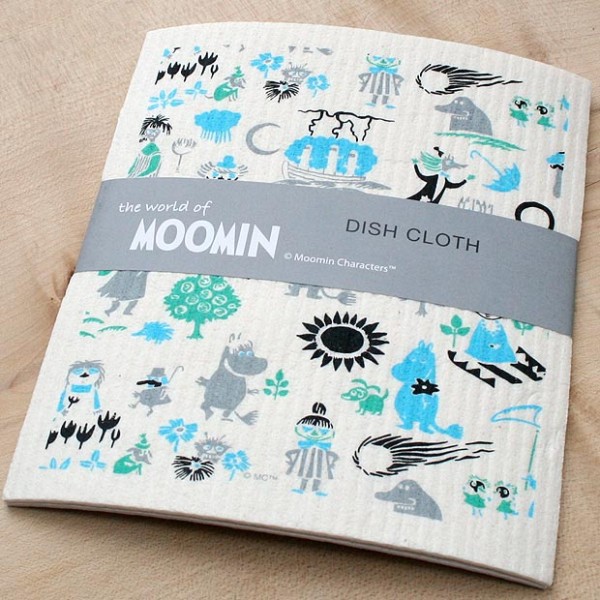
Moomin dishcloths! But not only Moomin dishcloths: they are plastic free Moomin dishcloths, made from cellulose material that can be washed and reused, and – when they can’t be washed any longer – can put in the compost bin. Genius! I am so going to buying some of these. My anti-plastic lifestyle just got a whole lot more stylish!
(Find Moomin at Waterstones)
Sunday, 22 May 2011
Like Minded People
 Isn't it lovely to meet people who are thinking about the same things as you are? Despite the prevalence of 'green' today, it's actually been a while since I really met anyone I could have a proper discussion with about the environment. I love my family and friends, absolutely, but 95% of them are hardened consumers. So: thank you Cape Farewell and Shortcourse/UK for introducing me to like-minded thinkers.
When I was invited to apply for Shortcourse/UK (see post below), I really wasn't sure what to expect. The launch evening, held at Newlyn Gallery, and with presentations by Sion Parkinson, Daro Montag and Nick Edwards, was intersting, but - to my mind - decidedly 'arty'. Now don't get me wrong, I'm all for arty stuff, I just find a lot of it to be beyond my understanding (or out of my zone of thinking, I guess), which means that I find it difficult to appreciate. But Shortcourse/UK sounded like such an interesting and unusual opportunity, I thought I'd apply for it anyway - and boy am I glad I did.
 The truth of the matter is that firstly, despite being a writer (or attempting to be one, anyway), I've never thought of myself as an artist; and secondly, I found it hard to see how artists could really make a difference to environmental issues. I enjoyed the first two expeditions with Shortcourse/UK, but coming home each evening I wasn't really sure if I'd learnt anything or gained anything. This weekend, however, was the third and final expedition, a two day trip to the Isles of Scilly, and it rather feels as if everything has now clicked into place.
The beauty of Cape Farewell is that it brings together scientists and artists, enabling the cross pollination of thoughts. It changes artists' thinking by more concisely introducing the science behing environmental concerns, and it changes scientists' thinking by introducing the art and the beauty and - essentially - the naturalness of the environments around us. I think that without my even really being aware of it, being surrounded by artists for the last two days has got me thinking in a distinctly more 'arty' way. And where two months ago I would have been somewhat sceptical about this, today I feel really excited about it and I'm really, really hoping I can hold onto this feeling.
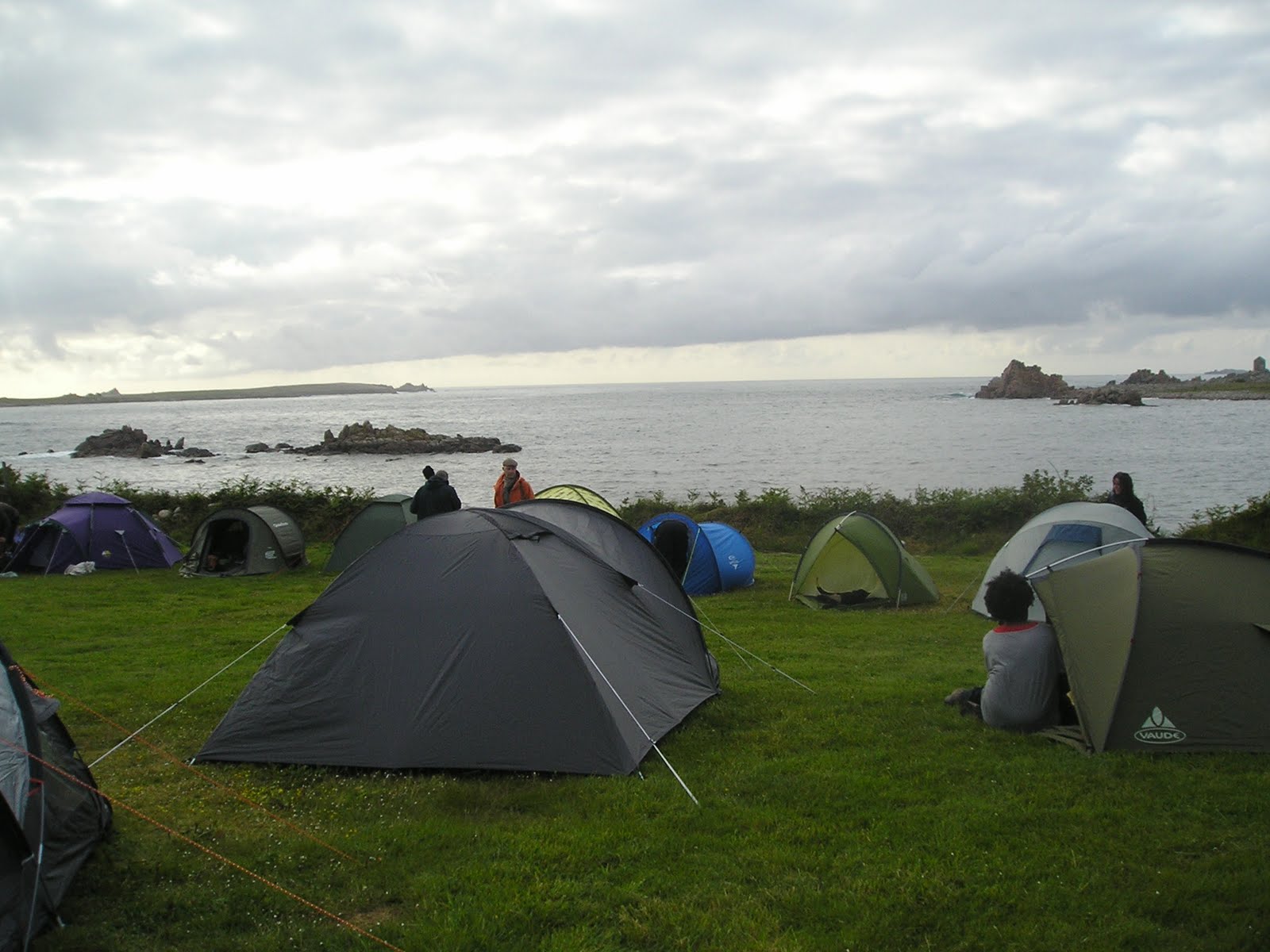 So what was so special about the Isles of Scilly expedition? Other than the Scillies being a pretty special place, it was immersion in the truest sense - immersion in the group of people I travelled with, immersion in the thinking and ideals of this group and its leaders, Sion and Daro, and immersion in the natural environment. After sleeping under canvas, right next to the sea, in a place with no light pollution, who wouldn't be thinking differently?
And as far as art and the environment goes, one of the best parts of the experience was listening to the presentations that the other students gave on their work, and discovering not only how art does communicate, but also how we're all like minded people. From Bryony, who is mid-way though a year rejecting consumerism, to Sonia's obsession with the sea, whales and plastic pollution, to Tom's research into the history of a field, generating some truly beautiful nature writing; Rob's investigation of ocean acidity, and Saffron, who is creating her own food range that highlights the absurdity of modern society's food attitudes. Each of them (and everyones else inthe group too) demonstrates that art and science do not have to be exclusive subjects. And I'm really looking forward to working with them more.


A bit of plastic here and there, but I couldn't find any nurdles (a good thing!). I imagine that the Islanders keepa close hold on the quality of their beaches. Interestingly, it seemed as if there was more glass than plastic around the beaches, though what that means, if anything, I don't know.
Sunday, 8 May 2011
Clay Country Plastic
I am very excited to have been given a place on a series of expeditions being organised by Cape Farewell. Called 'Shortcourse/UK' and run in conjunction with University College Falmouth and The Eden Project, it's described as "an initiative that looks to question and reform society’s notions of what art education can be". The general idea is to combine environmental and ecological thinking with art - thus using art and creative thinking to communicate ideas and issues about the environment and climate change.
I am by no means a photographer and only possess a standard digital camera, nothing fancy, but I thought I'd share some of the photos that I took on the first expedition on Friday. After starting at The Eden Project with an early morning sweat lodge ceremony, we then spent the rest of the day following the trails around the site in 'clay country' and thinking about the ecology of the landscape around us.
I spent most of the day thinking about the tug of war between man and nature, but the other thing that kept jumping out at me was the plastic rubbish. Now, as a tourist trail, I suppose this is inevitable, but none-the-less it served to remind me again of the plastic impact.


I am by no means a photographer and only possess a standard digital camera, nothing fancy, but I thought I'd share some of the photos that I took on the first expedition on Friday. After starting at The Eden Project with an early morning sweat lodge ceremony, we then spent the rest of the day following the trails around the site in 'clay country' and thinking about the ecology of the landscape around us.
I spent most of the day thinking about the tug of war between man and nature, but the other thing that kept jumping out at me was the plastic rubbish. Now, as a tourist trail, I suppose this is inevitable, but none-the-less it served to remind me again of the plastic impact.


Subscribe to:
Posts (Atom)